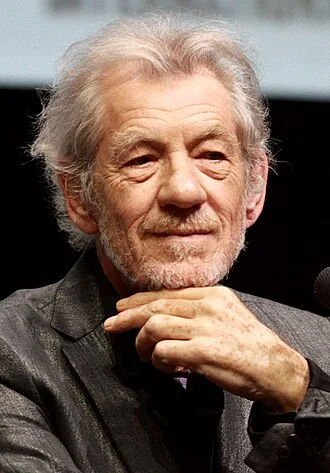
McKellen made his stage debut in 1961 at the Belgrade Theatre as a member of its repertory company, and in 1965 made his first West End appearance. In 1969, he was invited to join the Prospect Theatre Company to play the lead parts in Shakespeare's Richard II and Marlowe's Edward II. In the 1970s McKellen became a stalwart of the Royal Shakespeare Company and the National Theatre of Great Britain.
He has earned five Olivier Awards for his roles in Pillars of the Community (1977), The Alchemist (1978), Bent (1979), Wild Honey (1984), and Richard III (1995). McKellen made his Broadway debut in The Promise (1965). He went on to receive the Tony Award for Best Actor in a Play for his role as Antonio Salieri in Amadeus (1980).
He was further nominated for Ian McKellen: Acting Shakespeare (1984). He returned to Broadway in Wild Honey (1986), Dance of Death (1990), No Man's Land (2013), and Waiting for Godot (2013), the latter two being a joint production with Patrick Stewart.
McKellen achieved worldwide fame for his film roles, including King Richard III in Richard III (1995), James Whale in Gods and Monsters (1998), Magneto in the X-Men films (2000–2014; 2026), Cogsworth in Beauty and the Beast (2017) and Gandalf in The Lord of the Rings (2001–2003) and The Hobbit (2012–2014) trilogies.
He also appears in A Touch of Love (1969), Plenty (1985), Six Degrees of Separation (1993), Restoration (1995), Flushed Away (2006), Mr. Holmes (2015), and The Good Liar (2019).
McKellen came out as gay in 1988, and has since championed LGBT social movements worldwide. He was awarded the Freedom of the City of London in October 2014. McKellen is a cofounder of Stonewall, an LGBT rights lobby group in the United Kingdom, named after the Stonewall riots. He is patron of LGBT History Month, Pride London, Oxford Pride, GayGlos, LGBT Foundation and FFLAG.
Early life and education
McKellen was born on 25 May 1939 in Burnley, Lancashire, the son of Margery Lois (née Sutcliffe) and Denis Murray McKellen. He was their second child, with a sister, Jean, five years his senior. At four months old, shortly before the outbreak of the Second World War in September 1939, his family moved to Wigan. They lived there until Ian was twelve years old, before relocating to Bolton in 1951 after his father had been promoted.
The experience of living through the war as a young child had a lasting impact on him, and he later said that "only after peace resumed ... did I realise that war wasn't normal". When an interviewer remarked that he seemed quite calm in the aftermath of the 11 September attacks, McKellen said: "Well, darling, you forget—I slept under a steel plate until I was four years old".
McKellen's father was a civil engineer and lay preacher, and was of Protestant Irish and Scottish descent. Both of McKellen's grandfathers were preachers, and his great-great-grandfather, James McKellen, was a "strict, evangelical Protestant minister" in Ballymena, County Antrim. His home environment was strongly Christian, but non-orthodox. "My upbringing was of low nonconformist Christians who felt that you led the Christian life in part by behaving in a Christian manner to everybody you met".
When he was 12, his mother died of breast cancer; his father died when he was 25. After his coming out as gay to his stepmother, Gladys McKellen, who was a Quaker, he said, "Not only was she not fazed, but as a member of a society which declared its indifference to people's sexuality years back, I think she was just glad for my sake that I wasn't lying any more".
His great-great-grandfather Robert J. Lowes was an activist and campaigner in the ultimately successful campaign for a Saturday half-holiday in Manchester, the forerunner to the modern five-day work week, thus making Lowes a "grandfather of the modern weekend".
McKellen attended Bolton School (Boys' Division), of which he is still a supporter, attending regularly to talk to pupils. McKellen's acting career started at Bolton Little Theatre, of which he is now the patron. An early fascination with the theatre was encouraged by his parents, who took him on a family outing to Peter Pan at the Manchester Opera House when he was three.
When he was nine, his main Christmas present was a fold-away wood and bakelite Victorian theatre from Pollocks Toy Theatres, with cardboard scenery and wires to push on the cut-outs of Cinderella and of Laurence Olivier's reenactment of Shakespeare's "Hamlet".
His sister took him to his first Shakespeare play, Twelfth Night, by the amateurs of Wigan Little Theatre, shortly followed by their Macbeth and Wigan High School for Girls' production of A Midsummer Night's Dream, with music by Mendelssohn, with the role of Bottom played by Jean McKellen, who continued to act, direct, and produce amateur theatre until her death.
In 1958, McKellen, at the age of 18, won a scholarship to the University of Cambridge where he studied English literature as an undergraduate student of St Catharine's College, Cambridge. He has since been made an Honorary Fellow of the college. While at Cambridge, McKellen was a member of the Marlowe Society, where he appeared in 23 plays over the course of 3 years.
At that young age he was already giving performances that have since become legendary such as his Justice Shallow in Henry IV alongside Trevor Nunn and Derek Jacobi (March 1959), Cymbeline (as Posthumus, opposite Margaret Drabble as Imogen) and Doctor Faustus. During this period McKellen had already been directed by Peter Hall, John Barton and Dadie Rylands, all of whom would have a significant impact on McKellen's future career.
Career
1965–1985: National Theatre acclaim
McKellen made his first professional appearance in 1961 at the Belgrade Theatre in Coventry, as Roper in A Man for All Seasons, although an audio recording of the Marlowe Society's Cymbeline had gone on commercial sale as part of the Argo Shakespeare series. After four years in regional repertory theatres, McKellen made his first West End appearance, in A Scent of Flowers, regarded as a "notable success".
In 1965, he was a member of Laurence Olivier's National Theatre Company at the Old Vic, which led to roles at the Chichester Festival. With the Prospect Theatre Company, McKellen made his breakthrough performances of Shakespeare's Richard II (directed by Richard Cottrell) and Christopher Marlowe's Edward II (directed by Toby Robertson) at the Edinburgh Festival in 1969, the latter causing a storm of protest over the enactment of the homosexual Edward's lurid death.
One of his first major roles on television was as the title character in the BBC's 1966 adaptation of David Copperfield, which achieved 12 million viewers on its initial airings. After some rebroadcasting in the late 60s, the master videotapes for the serial were wiped, and only four scattered episodes (3, 8, 9 and 11) survive as telerecordings, three of which feature McKellen as adult David.
McKellen had taken film roles throughout his career—beginning in 1969 with his role of George Matthews in A Touch of Love, and his first leading role was in 1980 as D. H. Lawrence in Priest of Love, but it was not until the 1990s that he became more widely recognised in this medium after several roles in blockbuster Hollywood films.
In 1969, McKellen starred in three films, Michael Hayes's The Promise, Clive Donner's epic film Alfred the Great, and Waris Hussein's A Touch of Love (1969).
In the 1970s, McKellen became a well-known figure in British theatre, performing frequently at the Royal Shakespeare Company and the Royal National Theatre, where he played several leading Shakespearean roles. From 1973 to 1974, McKellen toured the United Kingdom and Brooklyn Academy of Music portraying Lady Wishfort's Footman, Kruschov, and Edgar in the William Congreve comedy The Way of the World, Anton Chekhov's comedic three-act play The Wood Demon and William Shakespeare tragedy King Lear.
The following year, he starred in Shakespeare's King John, George Colman's The Clandestine Marriage, and George Bernard Shaw's Too True to Be Good. From 1976 to 1977, he portrayed Romeo in the Shakespeare romance Romeo & Juliet at the Royal Shakespeare Theatre. The following year he played King Leontes in The Winter's Tale.
In 1976, he played the title role in William Shakespeare's Macbeth at Stratford in a "gripping ... out of the ordinary" production, with Judi Dench, and Iago in Othello, in award-winning productions directed by Trevor Nunn. Both of these productions were adapted into television films, also directed by Nunn.
From 1978 to 1979, he toured in a double feature production of Shakespeare's Twelfth Night, and Anton Chekov's Three Sisters portraying Sir Toby Belch and Andrei, respectively. In 1979, McKellen gained acclaim for his role as Antonio Salieri in the Broadway transfer production of Peter Shaffer's play Amadeus.
It was an immensely popular play produced by the National Theatre originally starring Paul Scofield. The transfer starred McKellen, Tim Curry as Wolfgang Amadeus Mozart, and Jane Seymour as Constanze Mozart. The New York Times theatre critic Frank Rich wrote of McKellen's performance "In Mr. McKellen's superb performance, Salieri's descent into madness was portrayed in dark notes of almost bone-rattling terror". For his performance, McKellen received the Tony Award for Best Actor in a Play.
In 1981, McKellen portrayed writer and poet D. H. Lawrence in the Christopher Miles directed biographical film, Priest of Love. He followed up with Michael Mann's horror film The Keep (1983). In 1985, he starred in Plenty, the film adaptation of the David Hare play of the same name. The film was directed by Fred Schepisi and starred Meryl Streep, Charles Dance, John Gielgud, and Sting.
The film spans nearly 20 years from the early 1940s to the 1960s, around an Englishwoman's experiences as a fighter for the French Resistance during World War II when she has a one-night stand with a British intelligence agent. The film received mixed reviews with Roger Ebert of The Chicago Sun-Times praising the film's ensemble cast writing, "The performances in the movie supply one brilliant solo after another; most of the big moments come as characters dominate the scenes they are in".
1986–2000: Established actor
In 1986, he returned to Broadway in the revival of Anton Chekhov's first play Wild Honey alongside Kim Cattrall and Kate Burton. The play concerned a local Russian schoolteacher who struggles to remain faithful to his wife, despite the attention of three other women. McKellen received mixed reviews from critics in particular Frank Rich of The New York Times who praised him for his "bravura and athletically graceful technique that provides everything except, perhaps, the thing that matters most—sustained laughter".
He later wrote, "Mr. McKellen finds himself in the peculiar predicament of the star who strains to carry a frail supporting cast". In 1989 he played Iago in production of Othello by the Royal Shakespeare Company. McKellen starred in the British drama Scandal (1989) a fictionalised account of the Profumo affair that rocked the government of British prime minister Harold Macmillan.
McKellen portrayed John Profumo. The film starred Joanne Whalley, and John Hurt. The film premiered at the 1989 Cannes Film Festival and competed for the Palme d'Or. When his friend and colleague, Patrick Stewart, decided to accept the role of Captain Jean-Luc Picard in the American television series, Star Trek: The Next Generation, McKellen strongly advised him not to throw away his respected theatrical career to work in television.
However, McKellen later conceded that Stewart had been prudent in accepting the role, which made him a global star and later followed his example such as co-starring with Stewart in the X-Men superhero film series.
From 1990 to 1992, he acted in a world tour of a lauded revival of Richard III, playing the title character. The production played at the Brooklyn Academy of Music for two weeks before continuing its tour where Frank Rich of New York Times was able to review it. In his piece, he praised McKellen's performance writing, "Mr McKellen's highly sophisticated sense of theatre and fun drives him to reveal the secrets of how he pulls his victims' strings whether he is addressing the audience in a soliloquy or not". For his performance he received the Laurence Olivier Award for Best Actor.
In 1992, he acted in Pam Gems's revival of Chekov's Uncle Vanya at the Royal National Theatre alongside Antony Sher, and Janet McTeer. In 1993, he starred in the film Six Degrees of Separation based on the Pulitzer Prize and Tony Award nominated play of the same name. McKellen starred alongside Will Smith, Donald Sutherland and Stockard Channing.
The film was a critical success. That same year, he appeared in the western The Ballad of Little Jo opposite Bob Hoskins and the action comedy Last Action Hero starring Arnold Schwarzenegger. The following year, he appeared in the superhero film The Shadow with Alec Baldwin and the James L. Brooks directed comedy I'll Do Anything starring Nick Nolte.