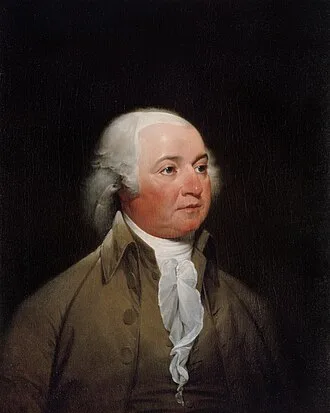
A lawyer and political activist prior to the Revolution, Adams was devoted to the right to counsel and presumption of innocence. He defied anti-British sentiment and successfully defended British soldiers against murder charges arising from the Boston Massacre. Adams was a Massachusetts delegate to the Continental Congress and became a leader of the revolution.
He assisted Jefferson in drafting the Declaration of Independence in 1776 and was its primary advocate in Congress. As a diplomat, he represented the United States in France and the Netherlands during the war. He helped negotiate the peace treaty with Great Britain, secured Dutch loans for the American government, and was the first United States ambassador to Great Britain.
Adams was the primary author of the Massachusetts Constitution in 1780, which, with his other political writings, influenced the United States Constitution.
Adams was elected to two terms as vice president under President George Washington and was elected as the United States' second president in 1796 under the banner of the Federalist Party. Adams's term was dominated by the issue of the French Revolutionary Wars, and his insistence on American neutrality led to fierce criticism from both the Jeffersonian Republicans and from some in his own party, led by his rival Alexander Hamilton.
Adams signed the controversial Alien and Sedition Acts and built up the Army and Navy in an undeclared naval war with France. He was the first president to reside in the White House.
In his 1800 bid for reelection to the presidency, opposition from Federalists and accusations of despotism from Jeffersonians led to Adams losing to his vice president and former friend, Thomas Jefferson. After his defeat, he retired to Massachusetts. He eventually resumed his friendship with Jefferson by initiating a continuing correspondence.
John Adams died on July 4, 1826 – the fiftieth anniversary of the adoption of the Declaration of Independence. The Adams political family included his son John Quincy Adams, the sixth president. Adams and his son are the only presidents of the first twelve who never owned slaves. Most historians have favorably ranked his administration.
Early life and education
John Adams was born on October 30, 1735, to John Adams Sr. and Susanna Boylston. He had two younger brothers, Peter and Elihu. Adams was born on the family farm in Braintree, Massachusetts. His mother was from a leading medical family of present-day Brookline, Massachusetts. His father was a deacon in the Congregational Church, a farmer, a cordwainer, and a lieutenant in the militia.
Adams often praised his father and recalled their close relationship. Adams's great-great-grandfather Henry Adams immigrated to Massachusetts from Braintree, Essex, England, around 1638.
Adams's formal education began at age six at a dame school, conducted at a teacher's home and centered on The New England Primer. He then attended Braintree Latin School under Joseph Cleverly, where studies included Latin, rhetoric, logic, and arithmetic. Adams's early education included incidents of truancy, a dislike for his master, and a desire to become a farmer, but his father commanded that he remain in school.
Deacon Adams hired a new schoolmaster named Joseph Marsh, and his son responded positively. Adams later noted that "As a child I enjoyed perhaps the greatest of blessings that can be bestowed upon men – that of a mother who was anxious and capable to form the characters of her children."
College education and adulthood
At age sixteen, Adams entered Harvard College in 1751, studying under Joseph Mayhew. As an adult, Adams was a keen scholar, studying the works of ancient writers such as Thucydides, Plato, Cicero, and Tacitus in their original languages. Though his father expected him to be a minister, after his 1755 graduation with an A.B. degree, he taught school temporarily in Worcester, while pondering his permanent vocation.
In the next four years, he began to seek prestige, craving "Honour or Reputation" and "more defference from [his] fellows", and was determined to be "a great Man". He decided to become a lawyer, writing his father that he found among lawyers "noble and gallant achievements" but, among the clergy, the "pretended sanctity of some absolute dunces".
He had reservations about his self-described "trumpery" and failure to share the "happiness of [his] fellow men".
When the French and Indian War began in 1754, Adams, aged nineteen, felt guilty he was the first in his family not to be a militia officer; he said "I longed more ardently to be a Soldier than I ever did to be a Lawyer".
Law practice and marriage
In 1756, Adams began reading law under James Putnam, a leading lawyer in Worcester. In 1758, he earned an A.M. from Harvard, and in 1759 was admitted to the bar. He developed an early habit of diary writing; this included his impressions of James Otis Jr.'s 1761 challenge to the legality of British writs of assistance, which allowed British officials to search a home without notice or reason. Otis's argument against the writs inspired Adams to the cause of the American colonies.
In 1763, Adams explored aspects of political theory in seven essays written for Boston newspapers. Under the pen name "Humphrey Ploughjogger", he ridiculed the selfish thirst for power he perceived among the Massachusetts colonial elite. Adams was initially less well known than his older cousin Samuel Adams, but his influence emerged from his work as a constitutional lawyer, his analysis of history, and his dedication to republicanism. Adams often found his own irascible nature a constraint in his political career.
In the late 1750s, Adams fell in love with Hannah Quincy; he was poised to propose but was interrupted by friends, and the moment was lost. In 1759, he met 15-year-old Abigail Smith, his third cousin, through his friend Richard Cranch, who was courting Abigail's older sister. Adams initially was not impressed with Abigail and her two sisters, writing that they were not "fond, nor frank, nor candid".
In time, Adams grew close to Abigail. They were married on October 25, 1764, despite the opposition of Abigail's mother. The pair shared a love of books and proved honest in their praise and criticism of each other. After his father's death in 1761, Adams had inherited a 9+1⁄2-acre (3.8 ha) farm and a house where they lived until 1783.
John and Abigail had six children: Abigail (known as "Nabby") in 1765, John Quincy in 1767, Susanna in 1768, Charles in 1770, Thomas in 1772, and Elizabeth in 1777. Susanna died when she was one year old, while Elizabeth was stillborn. All three of Adams's sons became lawyers. Charles and Thomas were largely unsuccessful and became alcoholics. In contrast, John Quincy excelled and launched a political career, eventually becoming president himself.
Career before the Revolution
Opponent of Stamp Act
Adams rose to prominence leading widespread opposition to the Stamp Act. The Act was passed by the British Parliament without consulting colonial American legislatures, and required payment of a direct tax by the colonies for stamped documents, and was designed to pay for the costs of the Seven Years' War. Power of enforcement was given to British vice admiralty courts, rather than common law courts.
These Admiralty courts acted without juries and were greatly disliked. The Act was despised for both its monetary cost and implementation without colonial consent, and encountered violent resistance, preventing its enforcement. Adams authored the "Braintree Instructions" in 1765, in a letter sent to the representatives of Braintree in the Massachusetts legislature.
It explained that the Act should be opposed since it denied two fundamental rights guaranteed to all Englishmen (and which all free men deserved): to be taxed only by consent and to be tried by a jury of one's peers. The instructions were a succinct and forthright defense of colonial rights and liberties, and served as a model for other towns.
Adams also reprised his pen name "Humphrey Ploughjogger" in opposition to the Stamp Act in August of that year. Included were four articles to the Boston Gazette. The articles were republished in The London Chronicle in 1768 as True Sentiments of America, or A Dissertation on the Canon and Feudal Law.
He also spoke in December before the governor and council, pronouncing the Stamp Act invalid in the absence of Massachusetts representation at Parliament. He noted that many protests were sparked by a popular sermon of Boston minister Jonathan Mayhew, invoking Romans 13 to justify insurrection. While Adams strongly opposed the Act in writing, he rebuffed attempts by Samuel Adams, a leader in the popular protest movements, to involve him in mob actions and public demonstrations. In 1766, a town meeting of Braintree elected Adams as a selectman.
With the repeal of the Stamp Act in early 1766, tensions with Britain temporarily eased. Putting politics aside, Adams moved his family to Boston in April 1768 to focus on his law practice. The family rented a house on Brattle Street that was known locally as the "White House". He, Abigail, and the children lived there for a year, then moved to Cold Lane; later they moved again to a larger house in Brattle Square in the center of the city.
In 1768, Adams successfully defended the merchant John Hancock, who was accused of violating British acts of trade in the Liberty Affair. With the death of Jeremiah Gridley and the mental collapse of James Otis Jr., Adams became Boston's most prominent lawyer. On June 7, 1770, Adams succeeded James Bowdoin, who had vacated his seat, as a member of the Massachusetts House of Representatives. He served in this capacity until April 16, 1771.
Counsel for the British: Boston Massacre
Britain's passage of the Townshend Acts in 1767 revived tensions, and an increase in mob violence led the British to dispatch more troops to the colonies. On March 5, 1770, when a mob accosted a lone British sentry, eight of his fellow soldiers reinforced him, and the crowd around them grew to several hundred. The soldiers were struck with snowballs, ice, and stones, and in the chaos the soldiers opened fire, killing five civilians, in the infamous Boston Massacre.
The accused soldiers were arrested on charges of murder. When no other attorneys would come to their defense, Adams decided to do so despite the risk to his reputation. He believed no person should be denied the right to counsel and a fair trial. The trials were delayed so that passions could cool.
The week-long trial of the commander, Captain Thomas Preston, began on October 24 and ended in his acquittal, because it was impossible to prove that he had ordered his soldiers to fire. The remaining soldiers were tried in December when Adams made his famed argument regarding jury decisions: "Facts are stubborn things; and whatever may be our wishes, our inclinations, or the dictates of our passions, they cannot alter the state of facts and evidence".
Adams won an acquittal for six of the soldiers. Two, who had fired directly into the crowd, were convicted of manslaughter. Adams was paid a small sum by his clients.
According to biographer John E. Ferling, during jury selection Adams "expertly exercised his right to challenge individual jurors and contrived what amounted to a packed jury. Not only were several jurors closely tied through business arrangements to the British army, but five ultimately became Loyalist exiles." While Adams's defense was helped by a weak prosecution, he "performed brilliantly." Ferling surmises that Adams was encouraged to take the case in exchange for political office; one of Boston's seats opened three months later in the Massachusetts legislature, and Adams was the town's choice to fill the vacancy.
The prosperity of his law practice increased from this exposure, as did the demands on his time. In 1771, Adams moved his family to Braintree, Massachusetts, but kept his office in Boston; he noted "Now my family is away, I feel no Inclination at all, no Temptation, to be any where but at my Office." After some time in the capital, he became disenchanted with the rural and "vulgar" Braintree as a home for his family – in August 1772, he moved them back to Boston.
He purchased a large brick house on Queen Street, not far from his office. In 1774, Adams and Abigail returned the family to the farm due to the increasingly unstable situation in Boston, and Braintree remained their permanent Massachusetts home.
American Revolution
Adams, who had been among the more conservative of the Founding Fathers, persistently held that while British actions against the colonies had been wrong, open insurrection was unwarranted and peaceful petition with the view of remaining part of Great Britain was preferable. His ideas began to change around 1772, as the British Crown assumed payment of the salaries of Governor Thomas Hutchinson and his judges instead of the Massachusetts legislature.
Adams wrote in the Gazette that these measures would destroy judicial independence and place the colonial government in closer subjugation to the Crown. After discontent among members of the legislature, Hutchinson delivered a speech warning that Parliament's powers over the colonies were absolute and that any resistance was illegal.
John Adams, Samuel, and Joseph Hawley drafted a resolution adopted by the House of Representatives threatening independence as an alternative to tyranny. The resolution argued that the colonists had never been under the sovereignty of Parliament: their charter, as well as their allegiance, was exclusive to the King.
The Boston Tea Party, a demonstration against the Tea Act and the British East India Company's tea monopoly over American merchants, took place on December 16, 1773. Protestors demolished 342 chests of tea worth about ten thousand pounds on the British schooner Dartmouth, anchored in Boston harbor. The Dartmouth owners briefly retained Adams as legal counsel regarding their liability for the destroyed shipment.
Adams applauded the destruction of the tea, calling it the "grandest Event" in the history of the colonial protest movement, and writing in his diary that it was an "absolutely and indispensably" necessary action.
Continental Congress
Member of Continental Congress
In 1774, at the instigation of Samuel Adams, the First Continental Congress was convened in response to the Intolerable Acts, a series of deeply unpopular measures intended to punish Massachusetts, centralize authority in Britain, and prevent rebellion in other colonies. Four delegates were chosen by the Massachusetts legislature, including John Adams, who agreed to attend, despite an emotional plea from his friend, Attorney General Jonathan Sewall, not to.
Shortly after he arrived in Philadelphia, Adams was placed on the 23-member Grand Committee tasked with drafting a letter of grievances to King George III. The committee soon split into conservative and radical factions. Although the Massachusetts delegation was largely passive, Adams criticized conservatives such as Joseph Galloway, James Duane, and Peter Oliver who advocated a conciliatory policy towards the British or felt that the colonies had a duty to remain loyal to Britain, although his views at the time aligned with those of conservative John Dickinson.
Adams sought the repeal of objectionable policies, but at this stage he continued to see benefits in maintaining the ties with Britain. He renewed his push for the right to a jury trial. He complained of what he considered the pretentiousness of the other delegates, writing to Abigail, "I believe if it was moved and seconded that We should come to a Resolution that Three and two make five We should be entertained with Logick and Rhetorick, Law, History, Politicks and Mathematicks, concerning the Subject for two whole Days, and then We should pass the Resolution unanimously in the Affirmative." Adams ultimately helped engineer a compromise between the conservatives and the radicals.
The Congress disbanded in October after sending the petition to the King and showing its displeasure with the Intolerable Acts by endorsing the Suffolk Resolves, which called for a boycott of British goods.
Adams's absence was hard on Abigail, who was left alone to care for the family. She still encouraged her husband in his task, writing: "You cannot be, I know, nor do I wish to see you an inactive Spectator, but if the Sword be drawn I bid adieu to all domestick felicity, and look forward to that Country where there is neither wars nor rumors of War in a firm belief that thro the mercy of its King we shall both rejoice there together."
News of the opening hostilities with the British at the Battles of Lexington and Concord made Adams hope that independence would soon become a reality. Three days after the battle, he rode into a militia camp and, while reflecting positively on the high spirits of the men, was distressed by their poor condition and lack of discipline.
A month later, Adams returned to Philadelphia for the Second Continental Congress as the leader of the Massachusetts delegation. He moved cautiously at first, noting that the Congress was divided between Loyalists, those favoring independence, and those hesitant to take any position. He became convinced that Congress was moving in the proper direction – away from Great Britain.
Publicly, Adams supported "reconciliation if practicable," but privately agreed with Benjamin Franklin's confidential observation that independence was inevitable.
In June 1775, with a view of promoting union among the colonies against Great Britain, he nominated George Washington of Virginia as commander-in-chief of the army then assembled around Boston. He praised Washington's "skill and experience" as well as his "excellent universal character." Adams opposed various attempts, including the Olive Branch Petition, aimed at finding peace.
Invoking the already-long list of British actions against the colonies, he wrote, "In my opinion Powder and Artillery are the most efficacious, Sure, and infallibly conciliatory Measures We can adopt." After his failure to prevent the petition from being enacted, he wrote a private letter derisively referring to Dickinson as a "piddling genius." The letter was intercepted and published in Loyalist newspapers.
The well-respected Dickinson refused to greet Adams and he was for a time largely ostracized. Ferling writes, "By the fall of 1775 no one in Congress labored more ardently than Adams to hasten the day when America would be separate from Great Britain." In October 1775, Adams was appointed chief judge of the Massachusetts Superior Court, but he never served, and resigned in February 1777.
In response to queries from other delegates, Adams wrote the 1776 pamphlet Thoughts on Government, which laid out an influential framework for republican constitutions.
Independence
Throughout the first half of 1776, Adams grew increasingly impatient with what he perceived to be the slow pace of declaring independence. In the Second Continental Congress in Philadelphia, he helped push through a plan to outfit armed ships to launch raids on enemy vessels. Later in the year, he drafted the first set of regulations for the provisional navy.
Adams drafted the preamble to the Lee Resolution of colleague Richard Henry Lee. He developed a rapport with delegate Thomas Jefferson of Virginia, who had been slower to support independence but by early 1776 agreed that it was necessary. On June 7, 1776, Adams seconded the Lee Resolution, which stated that the colonies were "free and independent states."
Prior to independence being declared, Adams organized a Committee of Five charged with drafting a Declaration of Independence. He chose himself, Jefferson, Benjamin Franklin, Robert R. Livingston and Roger Sherman. Jefferson thought Adams should write the document, but Adams persuaded the committee to choose Jefferson.
Many years later, Adams recorded his reasoning to Jefferson: "Reason first, you are a Virginian, and a Virginian ought to appear at the head of this business. Reason second, I am obnoxious, suspected, and unpopular. You are very much otherwise. Reason third, you can write ten times better than I can." The Committee left no minutes, and the drafting process itself remains uncertain.
Accounts written years later by Jefferson and Adams, although frequently cited, are often contradictory. Although the first draft was written primarily by Jefferson, Adams assumed a major role. On July 1, the resolution was debated in Congress. It was expected to pass, but opponents such as Dickinson made a strong effort to oppose it.
Jefferson, a poor debater, remained silent while Adams argued for its adoption. Many years later, Jefferson hailed Adams as "the pillar of [the Declaration's] support on the floor of Congress, [its] ablest advocate and defender against the multifarious assaults it encountered." On July 2, Congress officially voted for independence.
Twelve colonies voted in the affirmative, while New York abstained. Dickinson was absent. On July 3, Adams wrote to Abigail that "yesterday was decided the greatest question which was ever debated in America, and a greater perhaps never was nor will be decided among men." He predicted that "[t]he second day of July, 1776, will be the most memorable epoch in the history of America," and would be celebrated annually. Congress approved the Declaration of Independence on July 4.
During the congress, Adams sat on ninety committees, chairing twenty-five, an unmatched workload among the congressmen. As Benjamin Rush reported, he was acknowledged "to be the first man in the House." In June 1776, Adams became head of the Board of War and Ordnance, charged with recording the officers in the army and their ranks, the disposition of troops throughout the colonies, and ammunition.
He was referred to as a "one man war department," working up to eighteen-hour days and mastering the details of raising, equipping and fielding an army under civilian control. Adams functioned as a de facto Secretary of War. He kept extensive correspondences with Continental Army officers concerning supplies, munitions, and tactics.
Adams emphasized to them the role of discipline in keeping an army orderly. He authored the "Plan of Treaties," laying out Congress's requirements for a treaty with France. He was worn out by the rigor of his duties and longed to return home. His finances were unsteady, and the money that he received as a delegate failed to cover his expenses. However, the crisis caused by the defeat of the American soldiers kept him at his post.
After defeating the Continental Army at the Battle of Long Island on August 27, 1776, British Admiral Richard Howe determined that a strategic advantage was at hand, and requested that Congress send representatives to negotiate peace. A delegation consisting of Adams, Franklin, and Edward Rutledge met with Howe at the Staten Island Peace Conference on September 11.
Howe's authority was premised on the states' submission, so the parties found no common ground. When Lord Howe stated he could view the American delegates only as British subjects, Adams replied, "Your lordship may consider me in what light you please, ... except that of a British subject." Adams learned many years later that his name was on a list of people specifically excluded from Howe's pardon-granting authority.
Adams was unimpressed with Howe and predicted American success. He was able to return home to Braintree in October before leaving in January 1777 to resume his duties in Congress.