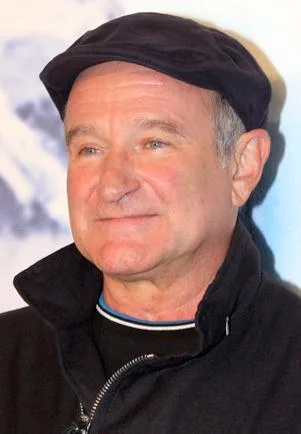
Born in Chicago, Williams began performing stand-up comedy in San Francisco and Los Angeles during the mid-1970s, and released several comedy albums including Reality ... What a Concept in 1980. He rose to fame playing the alien Mork in the ABC sitcom Mork & Mindy (1978–1982). Williams received his first leading film role in Popeye (1980).
He won the Academy Award for Best Supporting Actor for Good Will Hunting (1997). His other Oscar-nominated roles were for Good Morning, Vietnam (1987), Dead Poets Society (1989), and The Fisher King (1991).
Williams starred in the critically acclaimed dramas The World According to Garp (1982), Moscow on the Hudson (1984), Awakenings (1990), and World's Greatest Dad (2009), as well as the psychological thrillers Insomnia (2002) and One Hour Photo (2002). His feature film comedies and family films included Hook (1991), Toys (1992), Mrs.
Doubtfire (1993), Jumanji (1995), The Birdcage, Jack (both 1996), Flubber (1997), Patch Adams (1998), RV (2006), and the Night at the Museum series (2006–2014). He provided voice work in the animated films Aladdin (1992), Robots (2005), Happy Feet (2006), and Happy Feet Two (2011).
During his final years, Williams struggled with severe depression before his 2014 suicide at age 63. According to his widow, Williams had been diagnosed with Parkinson's disease, and had been experiencing depression, anxiety, and increasing paranoia. His autopsy found "diffuse Lewy body disease" whose symptoms professionals said were consistent with dementia with Lewy bodies. In the weeks following his suicide, Williams was celebrated in a wave of tributes.
Early life and education
Robin McLaurin Williams was born on July 21, 1951, at St. Luke's Hospital in Chicago, Illinois. His father, Robert Fitzgerald Williams (1906–1987), was a senior executive in Ford's Lincoln-Mercury Division. His mother, Laurie McLaurin (1922–2001), was a former model from Jackson, Mississippi, whose great-grandfather was Mississippi senator and governor Anselm J.
McLaurin. Williams had two older half-brothers: a paternal half-brother, Robert (also known as Todd), and a maternal half-brother, McLaurin. While his mother was a practitioner of Christian Science, Williams was raised in his father's Episcopal faith. During a television interview on Inside the Actors Studio in 2001, Williams credited his mother as an important early influence on his humor, and said he tried to make her laugh to gain attention.
Williams attended public elementary school at Gorton Elementary School in Lake Forest and later Deer Path Junior High School. He described himself as a quiet child who did not overcome his shyness until becoming involved with his high school drama department, while friends recalled him as being very funny. In late 1963, when Williams was 12, his father was transferred to Detroit.
The family lived in a 40-room farmhouse on 20 acres (8 ha) in suburban Bloomfield Hills, Michigan, where Williams attended the private all-boys Detroit Country Day School. He excelled academically, served as class president, and was on the school's wrestling team, but was also bullied for his weight and would play at home by himself.
With both parents working, Williams was partly raised by the family's maid, who was his main companion. When Williams was 16, his father took early retirement and the family moved to Tiburon, California. Following their move, Williams attended Redwood High School in nearby Larkspur. Williams described the school as Gestalt; he went on to join the drama club, becoming involved in theater, which first helped foster his interest in arts and entertainment.
At the time of his graduation in 1969, he was voted "Most Likely Not to Succeed" and "Funniest" by his classmates. After high school graduation, Williams enrolled at Claremont Men's College in Claremont, California, to study political science; he dropped out to pursue acting. Williams studied theater for three years at the College of Marin, a community college in Kentfield, California.
According to the College of Marin's drama professor, James Dunn, the depth of the young actor's talent became evident when Williams was cast in the musical Oliver! as Fagin. He often improvised during his time in the drama program, leaving cast members in hysterics. Dunn called his wife after one late rehearsal to tell her Williams "was going to be something special."
In 1973, Williams attained a full scholarship to the Juilliard School (Group 6, 1973–1976) in New York City. He was one of 20 students accepted into the freshman class, and Williams and Christopher Reeve were the only two accepted by John Houseman for the school's Advanced Program that year. Williams's classmates included William Hurt and Mandy Patinkin.
According to biographer Jean Dorsinville, Franklyn Seales and Williams were roommates at Juilliard. Reeve recalled his first impression of Williams when they were new students at Juilliard: "He wore tie-dyed shirts with tracksuit bottoms and talked a mile a minute. I'd never seen so much energy contained in one person.
He was like an untied balloon that had been inflated and immediately released. I watched in awe as he virtually caromed off the walls of the classrooms and hallways. To say that he was 'on' would be a major understatement."
Williams and Reeve had a class in dialects taught by Edith Skinner, who Reeve said was one of the world's leading voice and speech teachers. According to Reeve, Skinner was bewildered by Williams and his ability to instantly perform in many different accents.
Their primary acting teacher was Michael Kahn, who was "equally baffled by this human dynamo." Williams already had a reputation for being funny, but Kahn criticized his antics as simple stand-up comedy. In a later production, Williams silenced his critics with his well-received performance as an old man in Tennessee Williams's Night of the Iguana.
Reeve wrote, "He simply was the old man. I was astonished by his work and very grateful that fate had thrown us together." The two remained close friends until Reeve's death in 2004. Their friendship was like "brothers from another mother," according to Williams's son Zak.
During the summers of 1974 to 1976, Williams worked as a busboy at The Trident in Sausalito, California. He left Juilliard during his junior year in 1976, following Houseman's suggestion that the school had nothing more they could teach him. Gerald Freedman, another of his teachers at Juilliard, called Williams a "genius" and that the school's conservative and classical style of training did not suit him; to those who knew him, it came as no surprise that Williams left.
Career
1976–1982: Stand-up comedy and Mork & Mindy
Williams began performing stand-up comedy in the San Francisco Bay Area in 1976. His first performance took place at the Holy City Zoo, a San Francisco comedy club where he worked his way up from tending bar. During the 1960s, San Francisco had been a hub for rock music, the hippie movement, drugs, and a sexual revolution.
By the late 1970s, Williams played a leading role in what critic Gerald Nachman described as the city's "comedy renaissance." Reflecting on that era, Williams said that he found out about "drugs and happiness" during that period, adding that he saw "the best brains of my time turned to mud." Williams moved to Los Angeles and continued performing stand-up at clubs, including the Comedy Store.
There, in 1977, he was seen by television producer George Schlatter, who asked him to appear on a revival of his show Laugh-In. The show aired later that year and marked Williams's television debut. That same year, he performed a show at the L.A. Improv for Home Box Office. Although the Laugh-In revival failed, it opened doors for Williams's television career; he continued performing stand-up at comedy clubs such as the Roxy to help keep his improvisational skills sharp. Williams also took his act overseas and performed at the Fighting Cocks in London.
David Letterman, who knew Williams for nearly 40 years, recalled first seeing him perform as a newcomer at the Comedy Store in Hollywood. Letterman, already an established comedian at the time, described Williams's arrival as "like a hurricane", saying that he thought to himself, "Holy crap, there goes my chance in show business." Williams's first credited film role was a minor part in the 1977 low-budget comedy Can I Do It... 'Til I Need Glasses?.
However, his first starring performance was as the title character in Popeye (1980), in which Williams showcased the acting skills previously demonstrated in his television work. The film's commercial disappointment was not blamed on his performance.
Mork & Mindy
After the Laugh-In revival, and appearing in the cast of The Richard Pryor Show on NBC, Williams was cast by Garry Marshall as the alien Mork in the 1978 Happy Days episode "My Favorite Orkan". Sought after as a last-minute cast replacement for a departing actor, Williams impressed the producer with his quirky humor when he sat on his head when asked to take a seat for the audition.
As Mork, Williams improvised much of his dialogue and physical comedy, speaking in a high, nasal voice, and he made the most of the script. The cast and crew, as well as television network executives, were deeply impressed with Williams's performance. The executives moved quickly to sign Williams four days later before competitors could make their own offers.
Mork's appearance proved so popular with viewers that it led to the spin-off television sitcom Mork & Mindy, which co-starred Pam Dawber, and ran from 1978 to 1982; the show was written to accommodate his extreme improvisations in dialogue and behavior. Although he portrayed the same character as in Happy Days, the series was set in the present in Boulder, Colorado, instead of the late 1950s in Milwaukee. Mork & Mindy at its peak had a weekly audience of sixty million and was credited with turning Williams into a "superstar".
Among young people, the show was very popular because Williams became "a man and a child, buoyant, rubber-faced, an endless gusher of ideas", according to critic James Poniewozik.
Mork became popular, featured on posters, coloring books, lunch-boxes, and other merchandise. Mork & Mindy was such a success in its first season that Williams appeared on the March 12, 1979, cover of Time magazine. The cover photo, taken by Michael Dressler in 1979, is said to have "[captured] his different sides: the funnyman mugging for the camera, and a sweet, more thoughtful pose that appears on a small TV he holds in his hands,” according to Mary Forgione of the Los Angeles Times.
This photo was installed in the National Portrait Gallery in the Smithsonian Institution shortly after Williams died to allow visitors to pay their respects. He also appeared on the cover of the August 23, 1979, issue of Rolling Stone, photographed by Richard Avedon.
With his success on Mork & Mindy, Williams began to reach a wider audience with his stand-up comedy, starting in the late 1970s and throughout the 1980s, including three HBO comedy specials: Off The Wall (1978), An Evening with Robin Williams (1983), and A Night at the Met (1986). Williams won a Grammy Award for Best Comedy Album for the recording of his 1979 live show at the Copacabana in New York City, Reality ... What a Concept.
1982–1999: Film stardom and acclaim
Williams starred as the lead character in the comedy drama film The World According to Garp (1982), which he noted "may have lacked a certain madness onscreen, but it had a great core". Critic Roger Ebert wrote of his performance, "Although Robin Williams plays Garp as a relatively plausible, sometimes ordinary person, the movie never seems bothered by the jarring contrast between his cheerful pluckiness and the anarchy around him." Williams continued with the comedy drama film, Moscow on the Hudson (1984), where he played a Russian musician who defects to the United States.
Ebert noted, "The Russian is played by Robin Williams, who disappears so completely into his quirky, lovable, complicated character that he's quite plausible as a Russian". He had other smaller roles in less successful films, such as The Survivors (1983), The Best of Times (1986) and Club Paradise (1986).
In an interview with critic William Arnold in July 1986, Williams said, "My biggest problem in movies is that I'm a character actor. I don't like the pressure of having to carry the story, to have to advance the plot. It's hard. I guess I just don't want to be the total star. That's what attracted me to Club Paradise.
Producers have a hard time understanding that. That's not really what I do. I don't want to be Bogart: I want to be Peter Lorre. Give me a moustache and we'll talk." But Williams later said that those smaller roles in films like Club Paradise ultimately did not help advance his film career.
In 1986, Williams also co-hosted the 58th Academy Awards. The following year, he appeared in a sketch comedy special Carol, Carl, Whoopi and Robin (1987), acting alongside Carol Burnett, Carl Reiner, and Whoopi Goldberg. Williams was also a regular guest on various talk shows, including The Tonight Show Starring Johnny Carson and Late Night with David Letterman, on which he appeared 50 times.
Williams finally found his star-making role in director Barry Levinson's Good Morning, Vietnam (1987), which earned Williams a nomination for the Academy Award for Best Actor. The film is set in 1965 during the Vietnam War, with Williams playing the role of Adrian Cronauer, a radio shock jock who keeps troops entertained with comedy and sarcasm.
Williams was allowed to play the role without a script, improvising most of his lines. Over the microphone, Williams created voice impressions of various people, including Walter Cronkite, Gomer Pyle, Elvis Presley, Mr. Ed, and Richard Nixon. "We just let the cameras roll," said producer Mark Johnson, and Williams "managed to create something new for every single take".
Williams appeared opposite Steve Martin at Lincoln Center in an off-Broadway production of Waiting for Godot in 1988. In 1989, he played a private-school English teacher in Dead Poets Society, which included a final, emotional scene that some critics said "inspired a generation" and became a part of pop culture.
In Awakenings (1990), he plays a doctor modeled after Oliver Sacks, who wrote the book on which the film is based. Sacks later said the way Williams's mind worked was a "form of genius". Similarly, Williams's performance as a therapist in Good Will Hunting (1997) deeply affected even some real therapists. Williams won an Academy Award for Best Supporting Actor for his performance.
In 1991, Williams played an adult Peter Pan in the fantasy film Hook, although he had said that he would have to lose 25 pounds for the role. Similarly in 1995, he played Alan Parrish in the fantasy film Jumanji. Many of his roles during this time were in comedies or dramedies, including his Academy Award for Best Actor nominated performance as a troubled homeless man in The Fisher King (1991), an eccentric toymaker in Toys (1992), a divorced father who impersonates a nanny so he can spend time with his children in Mrs.
Doubtfire (1993), a gay man forced to act straight in The Birdcage (1996), a boy who ages four times faster than normal in Jack (1996), an absent-minded professor in Flubber (1997), and a real-life doctor who treats his patients with compassion and humor in Patch Adams (1998); many of these roles were tinged with pathos.
Terry Gilliam, who directed Williams in two of his films, The Adventures of Baron Munchausen (1988) and The Fisher King (1991), said in 1992 that Williams had the ability to "go from manic to mad to tender and vulnerable ... [Williams had] the most unique mind on the planet. There's nobody like him out there."
Williams also voiced characters in several animated films. He lent his voice to FernGully: The Last Rainforest (1992). In one of his most well-known voice roles, his character as the Genie in the animated musical Aladdin (1992) was written for Williams. The film's directors said that they had taken a risk by writing the role.
At first, Williams refused the role because it was a Disney movie and he did not want the studio profiting by selling merchandise based on the movie. Williams accepted the role with certain conditions: "I'm doing it basically because I want to be part of this animation tradition. I want something for my children. One deal is, I just don't want to sell anything—as in Burger King, as in toys, as in stuff." Williams improvised much of his dialogue, recording approximately 30 hours of tape, and impersonated dozens of celebrities, including Ed Sullivan, Jack Nicholson, Robert De Niro, Groucho Marx, Rodney Dangerfield, William F.
Buckley Jr., Peter Lorre, Arnold Schwarzenegger, and Arsenio Hall. Williams's role in Aladdin became one of his most recognized and best-loved, and the film was the highest-grossing of 1992; it won numerous awards, including a Special Golden Globe Award for Vocal Work in a Motion Picture for Williams. His performance paved the way for other animated films to incorporate actors with more star power. Williams was named a Disney Legend in 2009.
Due to Disney breaking an agreement with Williams regarding the use of the Genie in the advertising for Aladdin, he refused to sign for the direct-to-video sequel, The Return of Jafar (1994); the Genie was instead voiced by Dan Castellaneta. When Jeffrey Katzenberg was replaced by Joe Roth as Walt Disney Studios chairman, Roth organized a public apology to Williams.
He would, in turn, reprise the role in the second sequel, Aladdin and the King of Thieves (1996). Other dramatic performances by Williams include Kenneth Branagh's version of Hamlet (1996), What Dreams May Come (1998), and Bicentennial Man (1999). Williams appeared with fellow comedian, Billy Crystal, in an unscripted cameo at the beginning of a 1997 episode of the third season of Friends.[new archival link needed]
Looking over most of Williams's filmography, one writer was "struck by the breadth" and radical diversity of most of the roles Williams portrayed. Among the actors who helped Williams during his acting career, he credited Robert De Niro, from whom Williams learned the power of silence and economy of dialogue when acting.
From Dustin Hoffman, with whom Williams co-starred in Hook, he learned to take on totally different character types, and to transform his characters by extreme preparation. Mike Medavoy, producer of Hook, told its director, Steven Spielberg, that he intentionally teamed up Hoffman and Williams for the film because he knew they wanted to work together, and that Williams welcomed the opportunity of working with Spielberg.
Having Woody Allen, who directed him and Billy Crystal in Deconstructing Harry (1997), helped Williams. Allen knew that Crystal and Williams had often worked together on stage.