Billie Holiday
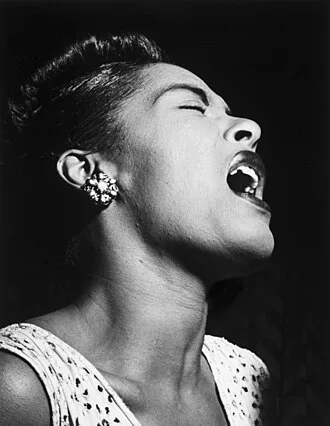
After a turbulent childhood, Holiday began singing in nightclubs in Harlem where she was heard by producer John Hammond, who liked her voice. Holiday signed a recording contract with Brunswick in 1935. Her collaboration with Teddy Wilson produced the hit "What a Little Moonlight Can Do", which became a jazz standard. Throughout the 1930s and 1940s, Holiday had mainstream success on labels such as Columbia and Decca.
However, by the late 1940s, she was beset with legal troubles and drug abuse. After a short prison sentence, Holiday performed a sold-out concert at Carnegie Hall. She was a successful concert performer throughout the 1950s, with two further sold-out shows at Carnegie Hall. Because of personal struggles and an altered voice, Holiday's final recordings were met with mixed reaction, but were mild commercial successes.
Her final album, "Billie Holiday" was released shortly before her death, in July 1959 and changed to "Last Recording" after her death. Holiday died of cirrhosis and heart failure on July 17, 1959, at age 44.
Holiday won four Grammy Awards, all of them posthumously, for Best Historical Album. She was inducted into the Grammy Hall of Fame and the National Rhythm & Blues Hall of Fame. In 2000, Holiday was also inducted into the Rock and Roll Hall of Fame as an early influence; their website states that "Billie Holiday changed jazz forever".
She was named one of the 50 Great Voices by NPR and was ranked fourth on the Rolling Stone list of "200 Greatest Singers of All Time" (2023). Several films about Holiday's life have been released, including Lady Sings the Blues (1972) and The United States vs. Billie Holiday (2021).
Life and career
1915–1929: Childhood
Eleanora Fagan was born on April 7, 1915, in Philadelphia to African American unwed teenage couple Clarence Halliday and Sarah Julia "Sadie" Fagan (née Harris). Her mother moved to Philadelphia at age 19, after being evicted from her parents' home in the Sandtown-Winchester neighborhood of Baltimore, Maryland, for becoming pregnant.
With no support from her parents, Sarah made arrangements with her older married half-sister, Eva Miller, for Holiday to stay with her in Baltimore.
Shortly after Holiday was born, her father abandoned his family to pursue a career as a jazz banjo player and guitarist. Some historians have disputed Holiday's paternity, as a copy of her birth certificate in the Baltimore archives lists her father as "Frank DeViese". Other historians consider this an anomaly, probably inserted by a hospital or government worker.
DeViese lived in Philadelphia, and Sadie, then known by her maiden name Harris, may have met him through her work. Harris married Philip Gough in 1920, but the marriage only lasted a few years.
Holiday grew up in Baltimore and had a very difficult childhood. Her mother often took what were then known as "transportation jobs", serving on passenger railroads. Holiday was raised largely by Eva Miller's mother-in-law, Martha Miller, and suffered from her mother's absences and being in others' care for her first decade of life.
Holiday's autobiography, Lady Sings the Blues, published in 1956, is inconsistent regarding details of her early life, but much was confirmed by Stuart Nicholson in his 1995 biography of the singer.[citation needed]
At the age of nine, Holiday attended school at Saint Frances Academy in Baltimore, frequently skipping classes, which resulted in her being brought before the juvenile court at age nine. She was sent to the House of the Good Shepherd, a Catholic reform school for girls, where the nuns locked her in a room with a dead girl overnight as punishment for misbehavior.
The experience traumatized her, and for years she would "dream about it and wake up hollering and screaming". After nine months, she was released on October 3, 1925, to her mother. Sadie had opened a restaurant, the East Side Grill, and they worked long hours there. She dropped out of school at age 11.
On December 24, 1926, Harris came home to discover a neighbor attempting to rape Holiday. She successfully fought back, and he was arrested. Officials sent Holiday back to the House of the Good Shepherd under protective custody as a state witness in the rape case. Holiday was released in February 1927, when she was nearly 12.
She found a job running errands in a brothel, and she scrubbed marble steps as well as kitchen and bathroom floors of neighborhood homes. Around this time, she first heard the records of Louis Armstrong and Bessie Smith. In particular, Holiday cited "West End Blues" as an intriguing influence, pointing specifically to the scat section duet with the clarinet as her favorite part.
By the end of 1928, Holiday's mother moved to Harlem, New York, again leaving Holiday with Martha Miller. By early 1929, Holiday had joined her mother in Harlem.[citation needed]
1929–1935: Early career
As a young teenager, Holiday started singing in nightclubs in Harlem. She took her professional pseudonym from Billie Dove, an actress she admired, and Clarence Halliday, her father. At the outset of her career, she spelled her last name "Halliday", her father's birth surname, but eventually changed it to "Holiday", his performing name.
The young singer teamed up with a neighbor, tenor saxophone player Kenneth Hollan. They were a team from 1929 to 1931, performing at clubs such as the Grey Dawn, Pod's and Jerry's on 133rd Street, and the Brooklyn Elks Club. Benny Goodman recalled hearing Holiday in 1931 at the Bright Spot. As her reputation grew, she played in many clubs, including the Mexico's and the Alhambra Bar and Grill, where she met Charles Linton, a vocalist who later worked with Chick Webb.
It was also during this period that she connected with her father, who was playing in Fletcher Henderson's band.
Late in 1932, 17-year-old Holiday replaced the singer Monette Moore at Covan's, a club on West 132nd Street. Producer John Hammond, who loved Moore's singing and had come to hear her, first heard Holiday there in early 1933. Hammond arranged for Holiday to make her recording debut at age 18, in November 1933, with Benny Goodman.
She recorded two songs: "Your Mother's Son-In-Law" and "Riffin' the Scotch", the latter being her first hit. "Son-in-Law" sold 300 copies, and "Riffin' the Scotch", released on November 11, sold 5,000 copies. Hammond was impressed by Holiday's singing style and said of her, "Her singing almost changed my music tastes and my musical life, because she was the first girl singer I'd come across who actually sang like an improvising jazz genius." Hammond compared Holiday favorably to Armstrong and said she had a good sense of lyric content at a young age.
In 1935, Holiday had a small role as a woman abused by her lover in Duke Ellington's musical short film Symphony in Black: A Rhapsody of Negro Life. She sang "Saddest Tale" in her scene.
1935–1938: Recordings with Teddy Wilson
In 1935, Holiday was signed to Brunswick by John Hammond to record pop tunes with pianist Teddy Wilson in the swing style for the growing jukebox trade. They were allowed to improvise on the material. Holiday's improvisation of melody to fit the emotion was highly skillful. Their first collaboration included "What a Little Moonlight Can Do" and "Miss Brown to You". "What a Little Moonlight Can Do" has been deemed her "claim to fame".
Brunswick did not favor the recording session because producers wanted Holiday to sound more like Cleo Brown. However, after "What a Little Moonlight Can Do" was successful, the company began considering Holiday an artist in her own right. She began recording under her own name a year later for Vocalion in sessions produced by Hammond and Bernie Hanighen.
Hammond said the Wilson–Holiday records from 1935 to 1938 were a great asset to Brunswick. According to Hammond, Brunswick was broke and unable to record many jazz tunes. Wilson, Holiday, Young, and other musicians came into the studio without written arrangements, reducing the recording cost. Brunswick paid Holiday a flat fee rather than royalties, which saved the company money. "I Cried for You" sold 15,000 copies, which Hammond called "a giant hit for Brunswick ... Most records that made money sold around three to four thousand."
Another frequent accompanist was tenor saxophonist Lester Young, who had been a boarder at her mother's house in 1934 and with whom Holiday had a rapport. Young said, "I think you can hear that on some of the old records, you know. Some time I'd sit down and listen to 'em myself, and it sound like two of the same voices ... or the same mind, or something like that." Young nicknamed her "Lady Day", and she called him "Prez".
1937–1938: Working for Count Basie and Artie Shaw
In late 1937, Holiday had a brief stint as a big-band vocalist with Count Basie. The traveling conditions of the band were often poor; they performed many one-nighters in clubs, moving from city to city with little stability. Holiday chose the songs she sang and had a hand in the arrangements, choosing to portray her developing persona of a woman unlucky in love.
Her tunes included "I Must Have That Man", "Travelin' All Alone", "I Can't Get Started", and "Summertime", a hit for Holiday in 1936, originating from George Gershwin's Porgy and Bess the year before. Basie became used to Holiday's heavy involvement in the band. He said, "When she rehearsed with the band, it was really just a matter of getting her tunes like she wanted them, because she knew how she wanted to sound and you couldn't tell her what to do." Some of the songs Holiday performed with Basie were recorded. "I Can't Get Started", "They Can't Take That Away from Me", and "Swing It Brother Swing" are all commercially available.
Holiday was unable to record in the studio with Basie, but she included many of his musicians in her recording sessions with Teddy Wilson.
Holiday found herself in direct competition with the popular singer Ella Fitzgerald. The two later became friends. Fitzgerald was the vocalist for the Chick Webb Band, which was in competition with the Basie band. On January 16, 1938, the same day that Benny Goodman performed his legendary Carnegie Hall jazz concert, the Basie and Webb bands had a battle at the Savoy Ballroom.
Webb and Fitzgerald were declared winners by Metronome magazine, while DownBeat magazine pronounced Holiday and Basie the winners. Fitzgerald won a straw poll of the audience by a three-to-one margin.
By February 1938, Holiday was no longer singing for Basie. Various reasons have been given for why she was fired. Jimmy Rushing, Basie's male vocalist, called her unprofessional. According to the AllMusic Guide, Holiday was fired for being "temperamental and unreliable". She complained of low pay and poor working conditions and may have refused to sing the songs requested of her or change her style.
Holiday was hired by Artie Shaw a month after being fired from the Count Basie Band. This association placed her among the first black women to work with a white orchestra, an unusual arrangement at that time. This was also the first time a black female singer employed full-time toured the segregated U.S. South with a white bandleader.
When Holiday faced racism, Shaw would often stick up for his vocalist. In her autobiography, Holiday describes an incident in which she was not permitted to sit on the bandstand with other vocalists because of racist policies. Shaw said to her, "I want you on the band stand like Helen Forrest, Tony Pastor and everyone else." When touring the South, Holiday would sometimes be heckled by members of the audience.
In Louisville, Kentucky, a man called her a "nigger wench" and requested she sing another song. Holiday lost her temper and had to be escorted off the stage.
By March 1938, Shaw and Holiday had been broadcast on New York City's powerful radio station WABC (the original WABC, now WHSQ). Because of their success, they were given an extra time slot to broadcast in April, which increased their exposure. The New York Amsterdam News reviewed the broadcasts and reported an improvement in Holiday's performance. Metronome reported that the addition of Holiday to Shaw's band put it in the "top brackets".
Holiday could not sing as often during Shaw's shows as she could in Basie's; the repertoire was more instrumental, with fewer vocals. Shaw was also pressured to hire a white singer, Nita Bradley, with whom Holiday did not get along but had to share a bandstand. In May 1938, Shaw won band battles against Tommy Dorsey and Red Norvo, with the audience favoring Holiday.
Although Shaw admired Holiday's singing in his band, saying she had a "remarkable ear" and a "remarkable sense of time", her tenure with the band was nearing an end.
In November 1938, Holiday was asked to use the service elevator at the Lincoln Hotel in New York City, instead of the one used by hotel guests, because white patrons of the hotels complained. This may have been the last straw for her. She left the band shortly after. Holiday spoke about the incident weeks later, saying, "I was never allowed to visit the bar or the dining room as did other members of the band ... [and] I was made to leave and enter through the kitchen." There are no surviving live recordings of Holiday with Shaw's band.
Because she was under contract to a different record label and possibly because of her race, Holiday was able to make only one record with Shaw, "Any Old Time". However, Shaw played clarinet on four songs she recorded in New York on July 10, 1936: "Did I Remember?", "No Regrets", "Summertime", and "Billie's Blues".
By the late 1930s, Holiday had toured with Count Basie and Artie Shaw, scored a string of radio and retail hits with Teddy Wilson, and became an established artist in the recording industry. Her songs "What a Little Moonlight Can Do" and "Easy Living" were imitated by singers across America and were quickly becoming jazz standards.
In September 1938, Holiday's single "I'm Gonna Lock My Heart" ranked sixth as the most-played song that month. Her record label, Vocalion, listed the single as its fourth-best seller for the same month, and it peaked at number 2 on the pop charts, according to Joel Whitburn's Pop Memories: 1890–1954.
1939: "Strange Fruit" and Commodore Records
Holiday was in the middle of recording for Columbia in the late 1930s when she was introduced to "Strange Fruit", a song by Abel Meeropol based on his poem about lynching. Meeropol, a Jewish schoolteacher from the Bronx, used the pseudonym "Lewis Allan" for the poem, which was set to music and performed at teachers' union meetings.
It was eventually heard by Barney Josephson, the proprietor of Café Society, an integrated nightclub in Greenwich Village, who introduced it to Holiday. She performed it at the club in 1939, with some trepidation, fearing possible retaliation. She later said that the imagery of the song reminded her of her father's death and that this played a role in her resistance to performing it.
For her performance of "Strange Fruit" at the Café Society, she had waiters silence the crowd when the song began. During the song's long introduction, the lights dimmed and all movement had to cease. As Holiday began singing, only a small spotlight illuminated her face. On the final note, all lights went out, and when they came back on, Holiday was gone.
Holiday said her father, Clarence Holiday, was denied medical treatment for a fatal lung disorder because of racial prejudice, and that singing "Strange Fruit" reminded her of the incident. "It reminds me of how Pop died, but I have to keep singing it, not only because people ask for it, but because twenty years after Pop died the things that killed him are still happening in the South", she wrote in her autobiography.
When Holiday's producers at Columbia found the subject matter too sensitive, Milt Gabler agreed to record it for his Commodore Records label on April 20, 1939. "Strange Fruit" remained in her repertoire for 20 years. She recorded it again for Verve. The Commodore release did not get any airplay, but the controversial song sold well, though Gabler attributed that mostly to the record's other side, "Fine and Mellow", which was a jukebox hit. "The version I recorded for Commodore", Holiday said of "Strange Fruit", "became my biggest-selling record". "Strange Fruit" was the equivalent of a top-twenty hit in the 1930s, selling a million records.
Holiday's popularity increased after "Strange Fruit". She received a mention in Time magazine. "I open Café Society as an unknown", Holiday said. "I left two years later as a star. I needed the prestige and publicity all right, but you can't pay rent with it." She soon demanded a raise from her manager, Joe Glaser.
Holiday returned to Commodore in 1944, recording songs she made with Teddy Wilson in the 1930s, including "I Cover the Waterfront", "I'll Get By", and "He's Funny That Way". She also recorded new songs that were popular at the time, including, "My Old Flame", "How Am I to Know?", "I'm Yours", and "I'll Be Seeing You", a number one hit for Bing Crosby.
She also recorded her version of "Embraceable You", which was inducted into the Grammy Hall of Fame in 2005.
1940–1947: Commercial success
Holiday's mother Sadie, nicknamed "The Duchess", opened a restaurant called Mom Holiday's. She used money from her daughter while playing dice with members of the Count Basie band, with whom she toured in the late 1930s. "It kept Mom busy and happy and stopped her from worrying and watching over me", Holiday said. Fagan began borrowing large amounts from Holiday to support the restaurant.
Holiday obliged but soon fell on hard times herself. "I needed some money one night and I knew Mom was sure to have some", she said. "So I walked in the restaurant like a stockholder and asked. Mom turned me down flat. She wouldn't give me a cent." The two argued, and Holiday shouted angrily, "God bless the child that's got his own", and stormed out.
With Arthur Herzog Jr., a pianist, she wrote a song based on the lyric, "God Bless the Child", and added music. "God Bless the Child" became Holiday's most popular and most covered record. It reached number 25 on the charts in 1941 and was third in Billboard's songs of the year, selling over a million records.
In 1976, the song was added to the Grammy Hall of Fame. Herzog claimed Holiday contributed only a few lines to the lyrics. He said she came up with the line "God bless the child" from a dinner conversation the two had had.
On June 12, 1942, in Los Angeles, Holiday recorded "Trav'lin' Light" with Paul Whiteman for a new label, Capitol Records. Because she was under contract to Columbia, she used the pseudonym "Lady Day". The song reached number 23 on the pop charts and number one on the R&B charts, then called the Harlem Hit Parade. On October 11, 1943, Life magazine wrote, "She has the most distinctive style of any popular vocalist, [and] is imitated by other vocalists."
Milt Gabler, in addition to owning Commodore Records, became an A&R man for Decca Records. He signed Holiday to Decca on August 7, 1944, when she was 29. Her first Decca recording was "Lover Man" (number 16 Pop, number 5 R&B), one of her biggest hits. The success and distribution of the song made Holiday a staple in the pop community, leading to solo concerts, rare for jazz singers in the late 1940s.
Gabler said, "I made Billie a real pop singer. That was right in her. Billie loved those songs." Jimmy Davis and Roger "Ram" Ramirez, the song's writers, had tried to interest Holiday in the song. In 1943, a flamboyant male torch singer, Willie Dukes, began singing "Lover Man" on 52nd Street. Because of his success, Holiday added it to her shows.
The record's flip side was "No More", one of her favorites. Holiday asked Gabler for strings on the recording. Such arrangements were associated with Frank Sinatra and Ella Fitzgerald. "I went on my knees to him", Holiday said. "I didn't want to do it with the ordinary six pieces. I begged Milt and told him I had to have strings behind me." On October 4, 1944, Holiday entered the studio to record "Lover Man", saw the string ensemble and walked out.
The musical director, Toots Camarata, said Holiday was overwhelmed with joy. She may also have wanted strings to avoid comparisons between her commercially successful early work with Teddy Wilson and everything produced afterwards. Her 1930s recordings with Wilson used a small jazz combo; recordings for Decca often involved strings.
A month later, in November, Holiday returned to Decca to record "That Ole Devil Called Love", "Big Stuff", and "Don't Explain". She wrote "Don't Explain" after she caught her husband, Jimmy Monroe, with lipstick on his collar.
Holiday did not make any more records until August 1945, when she recorded "Don't Explain" for a second time, changing the lyrics "I know you raise Cain" to "Just say you'll remain" and changing "You mixed with some dame" to "What is there to gain?" Other songs recorded were "Big Stuff", "What Is This Thing Called Love?", and "You Better Go Now".
Ella Fitzgerald named "You Better Go Now" her favorite recording of Holiday's. "Big Stuff" and "Don't Explain" were recorded again but with additional strings and a viola. In 1946, Holiday recorded "Good Morning Heartache". Although the song failed to chart, she sang it in live performances; three live recordings are known.
In September 1946, Holiday began her only major film, New Orleans, in which she starred opposite Louis Armstrong and Woody Herman. Plagued by racism and McCarthyism, producer Jules Levey and script writer Herbert Biberman were pressed to lessen Holiday's and Armstrong's roles to avoid the impression that black people created jazz.
The attempts failed because, in 1947, Biberman was listed as one of the Hollywood Ten and sent to jail. Several scenes were deleted from the film. "They had taken miles of footage of music and scenes", Holiday said, but "none of it was left in the picture. And very damn little of me. I know I wore a white dress for a number I did ... and that was cut out of the picture." She recorded "The Blues Are Brewin'" for the film's soundtrack.
Other songs included in the movie are "Do You Know What It Means to Miss New Orleans?" and "Farewell to Storyville". Holiday's drug addictions were a problem on the set. She earned more than one thousand dollars per week from club ventures but spent most of it on heroin. Her lover, Joe Guy, traveled to Hollywood while Holiday was filming and supplied her with drugs. Guy was banned from the set when he was found there by Holiday's manager, Joe Glaser.
By the late 1940s, Holiday had begun recording a number of slow, sentimental ballads. Metronome expressed its concerns in 1946 about "Good Morning Heartache", saying, "there's a danger that Billie's present formula will wear thin, but up to now it's wearing well." The New York Herald Tribune reported of a concert in 1946 that her performance had little variation in melody and no change in tempo.
1947–1952: Legal issues and Carnegie Hall concert
By 1947, Holiday was at her commercial peak, having made $250,000 in the three previous years. She was ranked second in the DownBeat poll for 1946 and 1947, her highest ranking in that poll. She was ranked fifth in Billboard's annual college poll of "girl singers" on July 6, 1947 (Jo Stafford was first). In 1946, Holiday won the Metronome magazine popularity poll.
📚 Source: Wikipedia