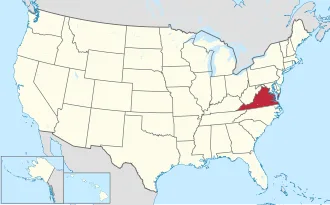
Eastern Virginia is part of the Atlantic Plain, and the Middle Peninsula forms the mouth of the Chesapeake Bay. Central Virginia lies predominantly in the Piedmont, the foothill region of the Blue Ridge Mountains, which cross the western and southwestern parts of the state. The fertile Shenandoah Valley fosters the state's most productive agricultural counties, while the economy in Northern Virginia is driven by technology companies and U.S. federal government agencies.
Hampton Roads is also the site of the region's main seaport and Naval Station Norfolk, the world's largest naval base.
Virginian history begins with several Indigenous groups, including the Powhatan. In 1607, the London Company established the Colony of Virginia as the first permanent English colony in the New World, leading to Virginia's nickname as the Old Dominion. Slaves from Africa and land from displaced native tribes fueled the growing plantation economy, but also fueled conflicts both inside and outside the colony.
Virginians fought for the independence of the Thirteen Colonies in the American Revolution, and helped establish the new national government. During the American Civil War, the state government in Richmond joined the Confederacy, while many northwestern counties remained loyal to the Union, which led to the separation of West Virginia in 1863.
Although the state was under one-party rule for nearly a century following the Reconstruction era, both major political parties have been competitive in Virginia since the repeal of racial segregation laws in the 1960s and 1970s. Virginia's state legislature is the Virginia General Assembly, which was established in July 1619, making it the oldest extant law-making body in North America.
Unlike other states, cities and counties in Virginia function as approximate equals, but the state government manages local roads in most counties. It is also the only state where governors are prohibited from serving consecutive terms.
History
Earliest inhabitants
Nomadic hunters are estimated to have arrived in Virginia around 17,000 years ago. Evidence from Daugherty's Cave shows it was regularly used as a rock shelter by 9,800 years ago. During the late Woodland period (500–1000 AD), tribes coalesced, and farming, first of corn and squash, began, with beans and tobacco arriving from the southwest and Mexico by the end of the period.
Palisaded towns began to be built around 1200. The native population in the current boundaries of Virginia reached around 50,000 in the 1500s. Large groups in the area at that time included the Algonquian in the Tidewater region, which they referred to as Tsenacommacah, the Iroquoian-speaking Nottoway and Meherrin to the north and south, and the Tutelo, who spoke Siouan, to the west.
In response to threats from these other groups to their trade network, 30 or so Virginia Algonquian-speaking tribes consolidated during the 1570s under Wahunsenacawh, known in English as Chief Powhatan. Powhatan controlled more than 150 settlements that had a total population of around 15,000 in 1607. Three-fourths of the native population in Virginia, however, died from smallpox and other Old World diseases during that century, disrupting their oral traditions and complicating research into earlier periods.
Additionally, many primary sources, including those that mention Powhatan's daughter, Pocahontas, were created by Europeans, who may have held biases or misunderstood native social structures and customs.
Colony
Several European expeditions, including a group of Spanish Jesuits, explored the Chesapeake Bay during the 16th century. To help counter Spain's colonies in the Caribbean, Queen Elizabeth I of England supported Walter Raleigh's 1584 expedition to the Atlantic coast of North America. The name "Virginia" was used by Captain Arthur Barlowe in the expedition's report, and may have been suggested by Raleigh or Elizabeth (perhaps noting her status as the "Virgin Queen" or that they viewed the land as being untouched) or related to an Algonquin phrase, Wingandacoa or Windgancon, or leader's name, Wingina, as heard by the expedition.
The name initially applied to the entire coastal region from South Carolina in the south to Maine in the north, along with the island of Bermuda. Raleigh's colony failed, but the potential financial and strategic gains still captivated many English policymakers. In 1606, King James I issued a charter for a new colony to the Virginia Company of London.
The group financed an expedition under Christopher Newport that established a settlement named Jamestown in 1607.
Though more settlers soon joined, many were ill-prepared for the dangers of the new settlement. As the colony's president, John Smith secured food for the colonists from nearby tribes, but after he left in 1609, this trade stopped and a series of ambush-style killings between colonists and natives under Chief Powhatan and his brother began, resulting in mass starvation in the colony that winter.
By the end of the colony's first 14 years, over 80% of the roughly eight thousand settlers transported there had died. Demand for exported tobacco, however, fueled the need for more workers. Starting in 1618, the headright system tried to solve this by granting colonists farmland for their help attracting indentured servants.
Enslaved Africans were first sold in Virginia in 1619. Though other Africans arrived as indentured servants and could be freed after four to seven years, the basis for lifelong slavery was developed in legal cases like those of John Punch in 1640 and John Casor in 1655. Laws passed in Jamestown defined slavery as race-based in 1661, as inherited maternally in 1662, and as enforceable by death in 1669.
From the colony's start, residents agitated for greater local control, and in 1619, certain male colonists began electing representatives to an assembly, later called the House of Burgesses, that negotiated issues with the governing council appointed by the London Company. Unhappy with this arrangement, the monarchy revoked the company's charter and began directly naming governors and Council members in 1624.
In 1635, colonists arrested a governor who ignored the assembly and sent him back to England against his will. William Berkeley was named governor in 1642, just as the turmoil of the English Civil War and Interregnum permitted the colony greater autonomy. As a supporter of the king, Berkeley welcomed other Cavaliers who fled to Virginia.
He surrendered to Parliamentarians in 1652, but after the 1660 Restoration made him governor again, he blocked assembly elections and exacerbated the class divide by disenfranchising and restricting the movement of indentured servants, who made up around 80 percent of the workforce. On the colony's frontier, tribes like the Tutelo and Doeg were being squeezed by Seneca raiders from the north, leading to more confrontations with colonists.
In 1676, several hundred working-class followers of Nathaniel Bacon, upset by Berkeley's refusal to retaliate against the tribes, burned Jamestown.
Bacon's Rebellion forced the signing of Bacon's Laws, which restored some of the colony's rights and sanctioned both attacks on native tribes and the enslavement of their people. The Treaty of 1677 further reduced the independence of the tribes that signed it, and aided the colony's assimilation of their land in the years that followed.
Colonists in the 1700s were pushing westward into the area held by the Seneca and their larger Iroquois Nation, and in 1748, a group of wealthy speculators, backed by the British monarchy, formed the Ohio Company to start English settlement and trade in the Ohio Country west of the Appalachian Mountains. France, which claimed this area as part of New France, viewed this as a threat, and in 1754 the French and Indian War engulfed England, France, the Iroquois, and other allied tribes on both sides.
A militia from several British colonies, called the Virginia Regiment, was led by Major George Washington, himself one of the investors in the Ohio Company.
Statehood
In the decade following the French and Indian War, the British Parliament passed new taxes which were deeply unpopular in the colonies. In the House of Burgesses, opposition to taxation without representation was led by Patrick Henry and Richard Henry Lee, among others. Virginians began to coordinate their actions with other colonies in 1773 and sent delegates to the Continental Congress the following year.
After the House of Burgesses was dissolved in 1774 by the royal governor, Virginia's revolutionary leaders continued to govern via the Virginia Conventions. On May 15, 1776, the Convention declared Virginia's independence and adopted George Mason's Virginia Declaration of Rights, which was then included in a new constitution that designated Virginia as a commonwealth.
Another Virginian, Thomas Jefferson, drew upon Mason's work in drafting the national Declaration of Independence.
After the American Revolutionary War began, George Washington was selected by the Second Continental Congress in Philadelphia to head the Continental Army, and many Virginians joined the army and revolutionary militias. Virginia was the first colony to ratify the Articles of Confederation in December 1777. In April 1780, the capital was moved to Richmond at the urging of Governor Thomas Jefferson, who feared that Williamsburg's coastal location would make it vulnerable to British attack.
In January 1781, Benedict Arnold's British forces raided Richmond before establishing a base at Portsmouth. The British army had over seven thousand soldiers and twenty-five warships stationed in Virginia at the beginning of 1781, but General Charles Cornwallis and his superiors were indecisive, and maneuvers by the three thousand soldiers under the Marquis de Lafayette and twenty-nine allied French warships together managed to confine the British to a swampy area of the Virginia Peninsula in September.
Around 16,000 soldiers under George Washington and Comte de Rochambeau quickly converged there and defeated Cornwallis in the siege of Yorktown. His surrender on October 19, 1781, led to peace negotiations in Paris and secured the independence of the colonies.
Virginians were instrumental in writing the United States Constitution. James Madison drafted the Virginia Plan in 1787 and the Bill of Rights in 1789, and Virginia ratified the Constitution on June 25, 1788. The three-fifths compromise ensured that Virginia, with its large number of slaves, initially had the largest bloc in the House of Representatives.
Together with the Virginia dynasty of presidents, this gave the Commonwealth national importance. Virginia is called the "Mother of States" because of its role in being carved into states such as Kentucky, and for the numbers of American pioneers born in Virginia.
Civil War
Between 1790 and 1860, the number of slaves in Virginia rose from around 290,000 to over 490,000, roughly one-third of the state population, and the number of slave owners rose to over 50,000. Both of these numbers represented the most in the U.S. The boom in Southern cotton production using cotton gins to harvest upland cotton increased the amount of labor needed, but new federal laws prohibited the importation of slaves.
Decades of monoculture tobacco farming had also degraded Virginia's agricultural productivity. Virginia plantations increasingly turned to exporting slaves, which broke up countless families and made the breeding of slaves, often through rape, a profitable business. Slaves in the Richmond area were also forced into industrial jobs, including mining and shipbuilding.
The failed slave uprisings of Gabriel Prosser in 1800, George Boxley in 1815, and Nat Turner in 1831, however, marked the growing resistance to slavery. Afraid of further uprisings, Virginia's government in the 1830s encouraged Free Blacks to migrate to Liberia.
On October 16, 1859, abolitionist John Brown led a raid on Harpers Ferry, Virginia, in an attempt to start a slave revolt across the southern states. The polarized national response to his raid, capture, trial, and execution that December marked a tipping point for many who believed slavery would need to be ended by force.
Abraham Lincoln's 1860 election further convinced many southern supporters of slavery that his opposition to its expansion would ultimately mean the end of slavery across the country. The seizure of Fort Sumter by Confederate forces on April 14, 1861, prompted Lincoln to call for the federalization of 75,000 militiamen.
The Virginia Secession Convention of 1861 voted on April 17 to secede on the condition it was approved in a referendum the next month. The convention voted to join the Confederacy, which named Richmond its capital on May 20. During the May 23 referendum, armed pro-Confederate groups prevented the casting and counting of votes from areas that opposed secession.
Representatives from 27 of these northwestern counties instead began the Wheeling Convention, which organized a government loyal to the Union and led to the separation of West Virginia as a new state.
The armies of the Union and Confederacy first met on July 21, 1861, at Bull Run near Manassas, Virginia, a bloody Confederate victory. Union General George B. McClellan organized the Army of the Potomac, which landed on the Virginia Peninsula in March 1862 and reached the outskirts of Richmond that June. With Confederate General Joseph E.
Johnston wounded in fighting outside the city, command of his Army of Northern Virginia fell to Robert E. Lee. Over the next month, Lee drove the Union army back, and starting that September led the first of several invasions into Union territory. During the next three years of war, more battles were fought in Virginia than anywhere else, including the battles of Fredericksburg, Chancellorsville, Spotsylvania, and the concluding Battle of Appomattox Court House, where Lee surrendered on April 9, 1865.
Reconstruction and segregation
Virginia was formally restored to the United States in 1870, due to the work of the Committee of Nine. During the post-war Reconstruction era, African Americans were able to unite in communities, particularly around Richmond, Danville, and the Tidewater region, and take a greater role in Virginia society; many achieved some land ownership during the 1870s.
Virginia adopted a constitution in 1868 which guaranteed political, civil, and voting rights, and provided for free public schools. However, with many railroad lines and other infrastructure destroyed during the Civil War, the Commonwealth was deeply in debt, and in the late 1870s redirected money from public schools to pay bondholders.
The Readjuster Party formed in 1877 and won legislative power in 1879 by uniting Virginians across racial lines behind a shared opposition to debt payments and the perceived plantation elites.
The Readjusters focused on building up schools, like Virginia Tech and Virginia State, and successfully forced West Virginia to share in the pre-war debt. But in 1883, they were divided by a proposed repeal of anti-miscegenation laws, and days before that year's election, a riot in Danville, involving armed policemen, left five men dead, four of whom were Black.
These events motivated a push by white supremacists to seize political power through voter suppression, and segregationists in the Democratic Party won the legislature that year and maintained control for decades. They passed Jim Crow laws that established a racially segregated society, and in 1902 rewrote the state constitution to include a poll tax and other voter registration measures that effectively disenfranchised most African-American and lower-income Virginians.