C. S. Lewis
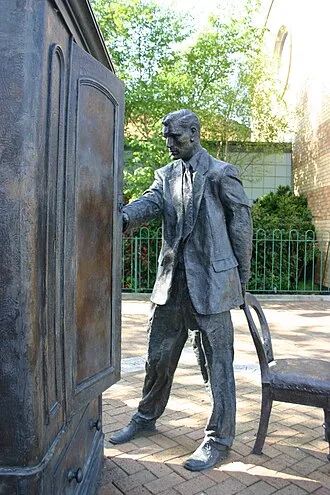
Lewis was a close friend of J. R. R. Tolkien, the author of The Lord of the Rings. Both men served on the English faculty at the University of Oxford and were active in the informal Oxford literary group known as the Inklings. According to Lewis's 1955 memoir Surprised by Joy, he was baptized in the Church of Ireland but fell away from his faith during adolescence.
Lewis returned to Anglicanism at the age of 32, owing to the influence of Tolkien and other friends, and he became an "ordinary layman of the Church of England". Lewis's faith profoundly affected his work, and his wartime radio broadcasts on the subject of Christianity brought him wide acclaim.
Lewis wrote more than 30 books which have been translated into over 30 languages and have sold millions of copies. The seven books that make up The Chronicles of Narnia have sold the most and have been popularized on stage, television, radio and cinema. His philosophical writings are widely cited by Christian scholars from many denominations.
In 1956 Lewis married the American writer Joy Davidman; she died of cancer four years later at the age of 45. Lewis died on 22 November 1963 of kidney failure, at age 64. In 2013, on the 50th anniversary of his death, Lewis was honoured with a memorial in Poets' Corner in Westminster Abbey.
Life
Childhood
Clive Staples Lewis was born in Belfast in Ulster, Ireland (before partition), on 29 November 1898. His father was Albert James Lewis (1863–1929), a solicitor whose father Richard Lewis had come to Ireland from Wales during the mid-19th century. Lewis's mother was Florence Augusta Lewis née Hamilton (1862–1908), known as Flora, the daughter of Thomas Hamilton, a Church of Ireland priest, and the great-granddaughter of both Bishop Hugh Hamilton and John Staples.
She was the first female mathematics graduate to study at Queen's College Belfast. Lewis had an elder brother, Warren Hamilton Lewis (known as "Warnie"). He was baptized on 29 January 1899 by his maternal grandfather in St Mark's Church, Dundela.
When his dog Jacksie was fatally struck by a horse-drawn carriage, the four-year-old Lewis adopted the name Jacksie. At first, he would answer to no other name, but later accepted Jack, the name by which he was known to friends and family for the rest of his life. When he was seven, his family moved into "Little Lea", the family home of his childhood, in the Strandtown area of East Belfast.
As a boy, Lewis was fascinated with anthropomorphic animals; he fell in love with Beatrix Potter's stories and often wrote and illustrated his own animal tales. Along with his brother Warnie, he created the world of Boxen, a fantasy world inhabited and run by animals. Lewis loved to read from an early age. His father's house was filled with books; he later wrote that finding something to read was as easy as walking into a field and "finding a new blade of grass".
The New House is almost a major character in my story.
I am the product of long corridors, empty sunlit rooms,
upstair indoor silences, attics explored in solitude,
distant noises of gurgling cisterns and pipes,
and the noise of wind under the tiles. Also, of endless books.
Lewis was schooled by private tutors until age nine, when his mother died in 1908 from cancer. His father then sent him to England to live and study at Wynyard School in Watford, Hertfordshire. Lewis's brother had enrolled there three years previously. Not long after, the school was closed due to a lack of pupils. Lewis then attended Campbell College in the east of Belfast about a mile from his home, but left after a few months due to respiratory problems.
He was then sent back to England to the health-resort town of Malvern, Worcestershire, where he attended the preparatory school Cherbourg House, which Lewis referred to as "Chartres" in his autobiography. It was during this time that he abandoned the Christianity he was taught as a child and became an atheist. During this time he also developed a fascination with European mythology and the occult.
In September 1913 Lewis enrolled at Malvern College, where he remained until the following June. He found the school socially competitive, and some of the fellow pupils of his house, such as Donald Hardman, had mixed feelings about him. Hardman later recalled:
He was a bit of a rebel; he had a wonderful sense of humour and was a past master of mimicry. I think he took his work seriously, but nothing else; never took any interest in games and never played any so for as I can remember unless he had to. ... I met him in Oxford after the war and noticed he had changed, but was staggered to find him the author of The Screwtape Letters.
When I knew him I can only describe him as a riotously amusing atheist. He really was pretty foul mouthed about it.
After leaving Malvern he studied privately with William T. Kirkpatrick, his father's old tutor and former headmaster of Lurgan College.
As a teenager Lewis was wonderstruck by the songs and legends of what he called Northernness, the ancient literature of Scandinavia preserved in the Icelandic sagas. These legends intensified an inner longing that he would later call "joy". He also grew to love nature; its beauty reminded him of the stories of the North, and the stories of the North reminded him of the beauties of nature.
His teenage writings moved away from the tales of Boxen, and he began experimenting with different art forms such as epic poetry and opera to try to capture his new-found interest in Norse mythology and the natural world.
Studying with Kirkpatrick ("The Great Knock", as Lewis afterward called him) instilled in him a love of Greek literature and mythology and sharpened his debate and reasoning skills. In 1916, Lewis was awarded a scholarship at University College, Oxford.
"My Irish life"
Lewis experienced a certain cultural shock on first arriving in England: "No Englishman will be able to understand my first impressions of England," Lewis wrote in Surprised by Joy. "The strange English accents with which I was surrounded seemed like the voices of demons. But what was worst was the English landscape ... I have made up the quarrel since; but at that moment I conceived a hatred for England which took many years to heal."
From boyhood, Lewis had immersed himself in Norse and Greek mythology, and later in Irish mythology and literature. He also expressed an interest in the Irish language, though there is not much evidence that he laboured to learn it. He developed a particular fondness for W. B. Yeats, in part because of Yeats's use of Ireland's Celtic heritage in poetry.
In a letter to a friend, Lewis wrote, "I have here discovered an author exactly after my own heart, whom I am sure you would delight in, W. B. Yeats. He writes plays and poems of rare spirit and beauty about our old Irish mythology."
In 1921 Lewis met Yeats twice, since Yeats had moved to Oxford. Lewis was surprised to find his English peers indifferent to Yeats and the Celtic Revival movement and wrote: "I am often surprised to find how utterly ignored Yeats is among the men I have met: perhaps his appeal is purely Irish – if so, then thank the gods that I am Irish." Early in his career, Lewis considered sending his work to the major Dublin publishers, writing: "If I do ever send my stuff to a publisher, I think I shall try Maunsel, those Dublin people, and so tack myself definitely onto the Irish school."
After his conversion to Christianity his interests gravitated towards Christian theology and away from pagan Celtic mysticism (as opposed to Celtic Christian mysticism).
Lewis occasionally expressed a somewhat tongue-in-cheek chauvinism towards the English. Describing an encounter with a fellow Irishman, he wrote: "Like all Irish people who meet in England, we ended by criticisms on the invincible flippancy and dullness of the Anglo-Saxon race. After all, there is no doubt, ami, that the Irish are the only people: with all their faults, I would not gladly live or die among another folk." Throughout his life he sought out the company of other Irish people living in England and visited Northern Ireland regularly. In 1958 he spent his honeymoon there at the Old Inn, Crawfordsburn, which he called "my Irish life".
Various critics have suggested that it was Lewis's dismay over the sectarian conflict in his native Belfast which led him to eventually adopt such an ecumenical brand of Christianity. As one critic has said, Lewis "repeatedly extolled the virtues of all branches of the Christian faith, emphasising a need for unity among Christians around what the Catholic writer G. K. Chesterton called 'Mere Christianity', the core doctrinal beliefs that all denominations share".
Paul Stevens of the University of Toronto opined that "Lewis' mere Christianity masked many of the political prejudices of an old-fashioned Ulster Protestant, a native of middle-class Belfast for whom British withdrawal from Northern Ireland even in the 1950s and 1960s was unthinkable."
First World War and Oxford University
Lewis entered Oxford in the 1917 summer term, studying at University College, and shortly after, he joined the Officers' Training Corps at the university as his "most promising route into the army". From there he was drafted into a Cadet Battalion for training. After his training he was commissioned into the 3rd Battalion of the Somerset Light Infantry of the British Army as a Second Lieutenant, and was later transferred to the 1st Battalion of the regiment, then serving in France (he would not remain with the 3rd Battalion as it moved to Northern Ireland).
Within months of entering Oxford, he was shipped by the British Army to France to fight in the First World War.
On his 19th birthday (29 November 1917) Lewis arrived at the front line in the Somme Valley in France, where he experienced trench warfare for the first time. On 15 April 1918, as 1st Battalion, Somerset Light Infantry assaulted the village of Riez du Vinage in the midst of the German spring offensive, Lewis was wounded and two of his colleagues were killed by a British shell falling short of its target.
He was depressed and homesick during his convalescence and, upon his recovery in October, he was assigned to duty in Andover, England. He was demobilized in December 1918 and soon restarted his studies. In a later letter, Lewis stated that his experience of the horrors of war, along with the loss of his mother and unhappiness in school, were the basis of his pessimism and atheism.
After Lewis returned to Oxford, he received a First in Honour Moderations (Greek and Latin literature) in 1920, a First in Greats (Philosophy and Ancient History) in 1922 and a First in English in 1923. In 1924 he became a philosophy tutor at University College and, in 1925, was elected a Fellow and Tutor in English Literature at Magdalen College, where he served for 29 years until 1954.
Janie Moore
During his army training, Lewis shared a room with another cadet, Edward Courtnay Francis "Paddy" Moore (1898–1918). Maureen Moore, Paddy's sister, said that the two made a mutual pact that if either died during the war, the survivor would take care of both of their families. Paddy was killed in action in 1918 and Lewis kept his promise.
Paddy had earlier introduced Lewis to his mother, Janie King Moore, and a friendship quickly sprang up between Lewis, who was 18 when they met, and Janie, who was 45. The friendship with Moore was particularly important to Lewis while he was recovering from his wounds in hospital, as his father did not visit him.
Lewis lived with and cared for Moore until she was hospitalized in the late 1940s. He routinely introduced her as his mother, referred to her as such in letters, and developed a deeply affectionate friendship with her. Lewis's own mother had died when he was a child, while his father was distant, demanding, and eccentric.
Speculation regarding their relationship resurfaced with the 1990 publication of A. N. Wilson's biography of Lewis. Wilson (who never met Lewis) attempted to make a case for their having been lovers for a time. Wilson's biography was not the first to address the question of Lewis's relationship with Moore. George Sayer knew Lewis for 29 years, and he had sought to shed light on the relationship during the period of 14 years before Lewis's conversion to Christianity. In his biography Jack: A Life of C. S. Lewis, he wrote:
Were they lovers? Owen Barfield, who knew Jack well in the 1920s, once said that he thought the likelihood was "fifty-fifty". Although she was twenty-six years older than Jack, she was still a handsome woman, and he was certainly infatuated with her. But it seems very odd, if they were lovers, that he would call her "mother".
We know, too, that they did not share the same bedroom. It seems most likely that he was bound to her by the promise he had given to Paddy and that his promise was reinforced by his love for her as his second mother.
Later Sayer changed his mind. In the introduction to the 1997 edition of his biography of Lewis he wrote:
I have had to alter my opinion of Lewis's relationship with Mrs. Moore. In chapter eight of this book I wrote that I was uncertain about whether they were lovers. Now after conversations with Mrs. Moore's daughter, Maureen, and a consideration of the way in which their bedrooms were arranged at The Kilns, I am quite certain that they were.
However, the romantic nature of the relationship is doubted by other writers; for example, Philip Zaleski and Carol Zaleski write in The Fellowship that
When—or whether—Lewis commenced an affair with Mrs. Moore remains unclear.
Lewis spoke well of Mrs. Moore throughout his life, saying to his friend George Sayer, "She was generous and taught me to be generous, too." In December 1917, Lewis wrote in a letter to his childhood friend Arthur Greeves that Janie and Greeves were "the two people who matter most to me in the world".
In 1930 Lewis moved into The Kilns with his brother Warnie, Mrs. Moore, and her daughter Maureen. The Kilns was a house in the district of Headington Quarry on the outskirts of Oxford, now part of the suburb of Risinghurst. They all contributed financially to the purchase of the house, which eventually passed to Maureen, who by then was Dame Maureen Dunbar, when Warren died in 1973.
Moore had dementia in her later years and was eventually moved into a nursing home, where she died in 1951. Lewis visited her every day in this home until her death.
Return to Christianity
Lewis was raised in a religious family that attended the Church of Ireland. He became an atheist at age 15, though he later described his young self as being paradoxically "very angry with God for not existing" and "equally angry with him for creating a world". His early separation from Christianity began when he started to view his religion as a chore and a duty; around this time, he also gained an interest in the occult, as his studies expanded to include such topics. Lewis quoted Lucretius (De rerum natura, 5.198–9) as having one of the strongest arguments for atheism:
Nequaquam nobis divinitus esse paratam
Naturam rerum; tanta stat praedita culpa
Lewis translated this poetically as follows:
Had God designed the world, it would not be
A world so frail and faulty as we see.
Lewis's interest in the works of the Scottish writer George MacDonald was part of what turned him from atheism. This can be seen particularly well through this passage in Lewis's The Great Divorce, chapter nine, when the semi-autobiographical protagonist meets MacDonald in Heaven:
I tried, trembling, to tell this man all that his writings had done for me. I tried to tell how a certain frosty afternoon at Leatherhead Station when I had first bought a copy of Phantastes (being then about sixteen years old) had been to me what the first sight of Beatrice had been to Dante: Here begins the new life.
I started to confess how long that Life had delayed in the region of imagination merely: how slowly and reluctantly I had come to admit that his Christendom had more than an accidental connexion with it, how hard I had tried not to see the true name of the quality which first met me in his books is Holiness.
He eventually returned to Christianity, having been influenced by arguments with his Oxford colleague and friend J. R. R. Tolkien, whom he seems to have met for the first time on 11 May 1926, as well as the book The Everlasting Man by G. K. Chesterton. Lewis vigorously resisted conversion, noting that he was brought into Christianity like a prodigal, "kicking, struggling, resentful, and darting his eyes in every direction for a chance to escape". He described his last struggle in Surprised by Joy:
You must picture me alone in that room in Magdalen [College, Oxford], night after night, feeling, whenever my mind lifted even for a second from my work, the steady, unrelenting approach of Him whom I so earnestly desired not to meet. That which I greatly feared had at last come upon me. In the Trinity Term of 1929 I gave in, and admitted that God was God, and knelt and prayed: perhaps, that night, the most dejected and reluctant convert in all England.
After his conversion to theism in 1929, Lewis converted to Christianity in 1931, following a long discussion during a late-night walk along Addison's Walk with his close friends Tolkien and Hugo Dyson. He records making a specific commitment to Christian belief while on his way to the zoo with his brother. He became a member of the Church of England – somewhat to the disappointment of Tolkien, who had hoped that he would join the Catholic Church.[page needed]
Lewis was a committed Anglican who upheld a largely orthodox Anglican theology, though in his apologetic writings, he made an effort to avoid espousing any one denomination. In his later writings, some believe that he proposed ideas such as purification of venial sins after death in purgatory (The Great Divorce and Letters to Malcolm) and mortal sin (The Screwtape Letters), which are generally considered to be Roman Catholic teachings, although they are also widely held in Anglicanism (particularly in high church Anglo-Catholic circles).
Regardless, Lewis considered himself an entirely orthodox Anglican to the end of his life, reflecting that he had initially attended church only to receive communion and had been repelled by the hymns and the poor quality of the sermons. He later came to consider himself honoured by worshipping with men of faith who came in shabby clothes and work boots and who sang all the verses to all the hymns.
Second World War
After the outbreak of the Second World War in 1939, the Lewises took child evacuees from London and other cities into The Kilns. Lewis was only 40 when the war began, and he tried to re-enter military service, offering to instruct cadets; however, his offer was not accepted. He rejected the recruiting office's suggestion of writing columns for the Ministry of Information in the press, as he did not want to "write lies" to deceive the enemy.
He later served in the local Home Guard in Oxford. From 1941 to 1943 Lewis spoke on religious programmes broadcast by the BBC from London while the city was under periodic air raids. These broadcasts were appreciated by civilians and servicemen at that stage. For example, Air Chief Marshal Sir Donald Hardman wrote "The war, the whole of life, everything tended to seem pointless. We needed, many of us, a key to the meaning of the universe. Lewis provided just that."
The youthful Alistair Cooke was less impressed, and in 1944 described "the alarming vogue of Mr. C.S. Lewis" as an example of how wartime tends to "spawn so many quack religions and Messiahs". The broadcasts were anthologized in Mere Christianity. From 1941 Lewis was occupied at his summer holiday weekends visiting Royal Air Force stations to speak on his faith, invited by Chaplain-in-Chief Maurice Edwards.
It was also during the same wartime period that Lewis was invited to become first President of the Oxford Socratic Club in January 1942, a position he enthusiastically held until he resigned on appointment to the University of Cambridge in 1954.
Honour declined
Lewis was named on the last list of honours by George VI in December 1951 as a Commander of the Order of the British Empire (CBE) but declined so as to avoid association with any political issues.
Chair at Cambridge University
In 1954 Lewis accepted the newly founded chair in Mediaeval and Renaissance Literature at Magdalene College, Cambridge, where he finished his career. He maintained a strong attachment to the city of Oxford, keeping a home there and returning on weekends until his death in 1963.
Joy Davidman
She was my daughter and my mother, my pupil and my teacher, my subject and my sovereign; and always, holding all these in solution, my trusty comrade, friend, shipmate, fellow-soldier. My mistress; but at the same time all that any man friend (and I have good ones) has ever been to me. Perhaps more.
📚 Source: Wikipedia