Humans first arrived in China during the Paleolithic. During the 2nd millennium BCE, dynastic states emerged. In 221 BCE, China was unified under the Qin, followed by the Han dynasty, ushering in two millennia of imperial rule across periods of unity and division. The imperial era saw the expansion of the Silk Road and the invention of gunpowder, paper, printing, and the compass.
After increased Western political, economic, and philosophical influence, the empire was succeeded by the Republic of China (ROC) after the 1911 Revolution. The Warlord Era and Chinese Civil War followed, interrupted by the Second Sino-Japanese War, which ended in a Chinese victory. In 1949, the Chinese Communist Party (CCP) proclaimed the PRC and the ROC retreated to Taiwan.
Both sides still claim political legitimacy. CCP attempts to advance its political program faltered through famine and political turmoil. The reform and opening-up that began in 1978 moved China towards a socialist market economy, spurring economic growth.
China is a unitary state with the CCP as its sole ruling party. It is one of the five permanent members of the UN Security Council and a member of many multilateral organizations. China is the world's largest manufacturer and has the second-largest economy by nominal GDP. International organizations have criticized China, alleging authoritarianism and human rights abuses.
Possessing a large military, space program, and nuclear stockpile, China has been described as a superpower due to its influence in geopolitics, science and technology, manufacturing, economics, and culture.
Chinese art and culture have influenced much of Asia, with a literary tradition dating back millennia to the Chinese classics. China is the birthplace of Confucianism and Daoism, which form the traditional three teachings of Chinese philosophy and folk religion alongside Buddhism. Chinese cuisine is diverse and highly regional, with rice as a staple in the south and wheat in the north.
It has 60 World Heritage Sites, including the Great Wall and Grand Canal. The Han, speakers of Sinitic languages, are China's dominant ethnicity, although it is home to 55 recognized minorities, including the Hui, Mongols, Tibetans, Uyghurs, and Zhuang.
Etymology
The word "China" has been used in English since the 16th century; however, it was not used by the Chinese themselves during this period. Its origin has been traced through Portuguese, Malay, and Persian back to the Sanskrit word Cīna (चिन), used in ancient India. Cīna was first used in early Hindu scriptures dating from the 3rd century BCE to 4th century CE, including the Mahabharata and the Laws of Manu.
In 1655, the missionary Martino Martini suggested that the word China is derived ultimately from the ancient state of Qin. This remains a common etymology. Another possible source is the ancient Guizhou polity of Yelang, known as ʐina in Loloish languages.
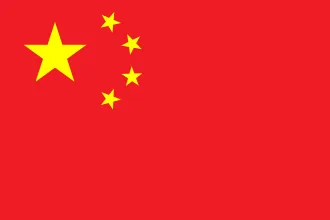
The official name of the modern state is the "People's Republic of China" (中华人民共和国; Zhōnghuá Rénmín Gònghéguó). The shorter form of this name is 中国; Zhōngguó, from zhōng ('central' or 'middle') and guó ('state'), a term first used for the demesne of the Western Zhou dynasty.
The names of ruling imperial dynasties were typically used to refer to the state and its territories. In the 1800s, Zhongguo was officially adopted as the name of the country by the Qing dynasty.
History
Prehistory
Evidence of early humans such as Homo erectus in China dates to the Paleolithic, around 1.7 million years ago, with unconfirmed sites as old as 2 million years ago. Modern Homo sapiens are attested from around 50,000 years ago. Following the end of the Last Glacial Period, in about 8,000 BCE, pottery-making Neolithic cultures emerged.
By the 6000s BCE, sedentary agricultural societies had spread across the lower Yellow River basin. These societies became increasingly complex, urbanized, and stratified, but many experienced a population collapse in the late 2000s BCE for unclear reasons.
Ancient China
After 2000 BCE, a Bronze Age culture emerged in the Central Plain, dubbed the Erlitou culture after its main site. Erlitou has been controversially identified with the Xia, the traditionally-accepted first dynasty, but no written records exist to confirm this. The Shang dynasty purportedly succeeded the Xia around 1600 BCE, with its early stages tentatively identified with an expansionist state known archaeologically as the Erligang culture.
The historicity of the Late Shang is attested through divinational writings in the oracle bone script. These are the earliest known form of writing in China and the ancestor of modern Chinese characters.
The Shang were overthrown by the Zhou c. 1046 BCE. The Zhou ruled over a vast and loose confederation of vassal states across central China, which was gradually weakened by regional lords. Centralized authority collapsed in 771 BCE, giving way to constant regional warfare.
During the Eastern Zhou, the multitude of small polities of the Spring and Autumn period evolved into seven territorial Warring States. Literary and philosophical developments of this period include the emergence of various schools of thought, such as Confucianism, Daoism, Mohism, and Legalism, alongside Chinese classics like the Confucian Analects and the Daoist Dao De Jing.
Imperial China
Classical period
In the 220s BCE, Qin rapidly conquered the other warring states. In 221, its ruler Qin Shi Huang proclaimed himself the first emperor (皇帝; Huángdì) and founded the Qin dynasty. He led an autocratic Legalist state organized in a system of commanderies and counties. The dynasty lasted only fifteen years, falling soon after his death from revolts and civil war.
After the collapse, the Han dynasty emerged to rule China between 206 BCE and 220 CE. The Han gradually reinstated centralized control, legitimizing their rule through Confucian scholarship and political institutions which would be maintained in some form into the 20th century. Military expeditions against the Xiongnu, a confederation of nomadic steppe tribes, expanded Han influence into parts of Central Asia and helped to establish the Silk Road, allowing for trade connections between China and western Eurasia.
Contemporaneously, merchants established maritime trade routes linking China, Southeast Asia, and India. The dynasty is the namesake of the Han Chinese, China's main ethnic group.
The Han faced widespread uprisings and the emergence of local warlords in the 100s and 200s CE. By 220, the empire was split into the Three Kingdoms. These were briefly united by the Jin dynasty in 280, which fell into civil war. Sinicized formerly-nomadic peoples who had settled in Northern China, such as the Xiongnu, rebelled and founded new dynasties.
Various Han Chinese dynasties in Southern China emerged in the 300s. During these conflicts, Buddhism was introduced to China via the Silk Road.
Mid-imperial period
China was reunited under the Sui dynasty in 589, which constructed the Grand Canal to link Northern and Southern China. The Sui collapsed in the 610s, and was succeeded by the Tang. The Tang dynasty centralized the state and dispatched military expeditions to pacify the surrounding regions. It promoted Buddhism, but through expanding international trade built a heavily cosmopolitan society centered on its capital of Chang'an.
It reformed the civil service examinations and oversaw a flourishing of art, poetry, architecture, and scholarship. The 755–763 An Lushan rebellion weakened the Tang, which gradually fragmented before collapsing completely in 907, resulting in another period of war and division.
The Song dynasty rose to power in 960. It faced military crises, unable to subdue its Sinicized non-Han neighbors, the Khitan-led Liao dynasty and the Tangut-led Western Xia. The Song's consistent focus on defense resulted in a heavily centralized state and military, which made the first military application of gunpowder.
Books became widely available by the proliferation of printing technology, while the elite class of scholar-officials grew increasingly powerful. Production, population, and trade expanded massively, alongside innovations such as industrial metallurgy and hydraulic machinery. The Song capital Kaifeng was overrun by the Jurchen-led Jin in 1127, forcing the Song to retreat to Southern China. During this period, the revivalist philosophical movement of Neo-Confucianism emerged.
Late imperial period
In 1206, Genghis Khan united the nomadic Mongols to the north under the Mongol Empire. Over the following fifty years, they conquered the Western Xia and the Jin, in addition to their other conquests as far west as Europe. The empire split into separate khanates, with Mongol leader Kublai Khan establishing the Yuan dynasty and subjugating the Song in the 1270s.
Although Chinese culture remained largely unchanged, the Yuan maintained a Mongol elite culture and established a complex ethnic and occupational hierarchy. Foreign presence increased as China became more connected to Eurasian trade routes.
In the 1340s, central China was devastated by disease, famine, and severe flooding along the Yellow River. Various rebellions erupted, leading to a peasant leader establishing the Ming dynasty in 1368 and declaring himself the Hongwu Emperor. The Ming later moved their capital from Nanjing to Beijing, with the Forbidden City as the imperial palace.
However, the lower Yangtze remained the wealthiest region. Trade grew, and the European colonization of the Americas brought new crops and a massive influx of silver to China. The population doubled, and a growing publishing industry began producing works in vernacular Chinese, including the Four Classic Novels.
The Ming state declined, and by the 1600s, became unable to contain peasant rebellions. The Manchus to the north declared the Qing dynasty in 1636 and conquered the Ming, killing their last claimant emperor in 1662 and conquering a Ming rump state on Taiwan in 1683. From the late 1600s to the end of the 1700s, the High Qing era saw economic growth and territorial expansion westward, including the conquest of Tibet and much of Central Asia.
European powers fought various wars against the Qing dynasty during the 19th century. These began with the United Kingdom's First Opium War in 1839–1842, which resulted in the first of the "unequal treaties" imposed on the dynasty. These opened treaty ports, allowed Christian missionary activity, and loosened trade restrictions.
China faced an economic crisis and internal unrest, and uprisings such as the 1850–1864 Taiping Rebellion resulted in the deaths of millions. Reformist factions of the Qing responded with the Self-Strengthening Movement, seeking to adopt Western weapons and technologies, but this had a limited impact for much of the empire.
The Empire of Japan's defeat of the Qing in the First Sino-Japanese War (1894–1895) resulted in the loss of Taiwan and the growth of both reformist and revolutionary political movements. An imperial push for reform in 1898 ended after an internal coup, while the anti-foreign Boxer Rebellion was defeated by a coalition of foreign powers in 1901.
The late Qing dynasty again advanced reforms, but growing revolutionary and anti-Manchu sentiment culminated in the 1911 Revolution. A coalition of revolutionaries led by Sun Yat-sen overthrew the Qing and declared the Republic of China (ROC) in 1912.
Republic of China
President Yuan Shikai rose to power in 1912 and crushed his main opposition, the Kuomintang, ruling China as a dictator until his death in 1916, following an abortive attempt to restore the monarchy. During the Warlord Era, feuding regional warlords and governors took power across China, while Tibet and Mongolia declared independence.
The nominal republican government had little control outside Beijing. During this period, New Culture intellectuals and students criticized traditional society. A crackdown on a student protest in 1919 led to the May Fourth Movement and further agitation by intellectuals for a cultural and political upheaval, with many embracing Western political ideas such as communism.
In the mid-1920s, the Kuomintang allied with the nascent Chinese Communist Party (CCP), and partially reunified China under Chiang Kai-shek's leadership. Starting with the Shanghai massacre in 1927, the Kuomintang violently purged the CCP and gained the allegiance of the northern warlords, establishing a new government at Nanjing. The CCP was driven into the countryside and repressed, but subsequently regrouped in the northwest.
Japan occupied Manchuria in 1931, and launched an invasion of the rest of China in 1937. A renewed coalition between the CCP and Kuomintang fought Japan in what became a theater of World War II, as Japanese forces committed numerous war atrocities against the civilian population and occupied most of China's major cities.
After the surrender of Japan in 1945, China became a founding member of the United Nations and regained control over Manchuria and Taiwan. The civil war between the CCP and the Kuomintang resumed the following year.
People's Republic of China
After a string of military victories, CCP chairman Mao Zedong formally proclaimed the People's Republic of China (PRC) in 1949. The ROC government retreated to Taiwan and continued to claim legitimacy. The following year, the PRC occupied and annexed Tibet. The PRC, which the CCP described as a "people's democratic dictatorship", enacted many reforms: it restructured the economy under state control, promoted literacy and gender equality, and expanded heavy industry.
The Land Reform Movement, in which the state encouraged and organized peasant violence against landlords, leading to the death of upwards of a million people, had begun in northern China during the civil war and extended to most of the rest of China between 1950 and 1952. It distributed landlord land to the peasants as private property, but it was soon followed by collectivization of the land.
In 1958, Mao launched the Great Leap Forward, a mass industrialization project which resulted in the Great Chinese Famine and millions of deaths. As the Cold War deepened, China grew politically isolated from its former ally, the Soviet Union, as well as the Western Bloc. It detonated its first atomic bomb in 1964. Attempting to reassert control over the CCP after the Great Leap, Mao and his allies launched the Cultural Revolution in 1966, sparking a decade of political violence, crackdowns on perceived counterrevolutionaries, and social upheaval that lasted until Mao's death in 1976.