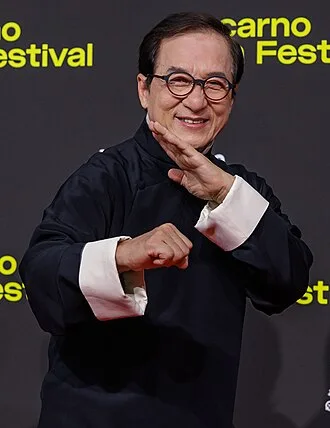
Starting as one of the Seven Little Fortunes at the China Drama Academy, where he was trained in acrobatics, martial arts and acting, Chan entered the Hong Kong film industry as a stuntman before making the transition to acting. His breakthrough came with the action comedy Snake in the Eagle's Shadow (1978). He then starred in similar action comedies such as Drunken Master (1978) and The Young Master (1980).
He made his directorial debut with The Fearless Hyena (1979), which was a box office success. Throughout the 1980s, he was part of the "Three Dragons" along with Sammo Hung and Yuen Biao; the three starred in six Hong Kong films together. Project A (1983) saw the official formation of the Jackie Chan Stunt Team and established Chan's signature style of elaborate, dangerous stunts combined with martial arts and slapstick humor, a style he further developed in a more modern setting with Wheels on Meals (1984) and Police Story (1985). Rumble in the Bronx (1995), which had a successful worldwide theatrical run, brought Chan into the North American mainstream. By the mid-1990s, he was the most popular action movie star in Eurasia.
Chan gained Hollywood success for portraying Chief Inspector Lee in the American buddy cop action comedy film Rush Hour (1998), a role he reprised in two sequels. He went on to work both in American and Chinese films, appearing in the Shanghai film series (2000–2003), New Police Story (2004), Rob-B-Hood (2006), Little Big Soldier (2010), Shaolin (2011), and The Shadow's Edge (2025), among others. The Forbidden Kingdom (2008) marked his first collaboration with fellow martial arts star Jet Li.
He has played martial arts mentor Mr. Han in two Karate Kid films, the 2010 remake The Karate Kid and Karate Kid: Legends (2025). For CZ12 (2012), he earned two Guinness World Records for "Most Stunts Performed by a Living Actor" and "Most Credits in One Movie". He played against type in Shinjuku Incident (2009) and The Foreigner (2017).
His voice acting work includes all three Chinese versions of Mulan (1998), the first three films in the Kung Fu Panda franchise (2008–2016), and Teenage Mutant Ninja Turtles: Mutant Mayhem (2023).
One of the most recognizable and influential film personalities in the world, Chan was described by film scholar Andrew Willis in 2004 as perhaps "the most recognized star in the world." He has received fame stars on the Hong Kong Avenue of Stars and the Hollywood Walk of Fame, as well as an honorary Academy Award in 2016.
Chan has been referenced in various pop songs, films, television series, and video games. He has an award named after him, the Jackie Chan Action Movie Awards. He is an operatically trained vocalist who has released several pop music albums and performed theme songs for some of the films in which he starred. He is also a philanthropist and was named one of the top 10 most charitable celebrities by Forbes in 2011. In 2016, Forbes ranked him the second-highest-paid actor in the world.
Early life
Chan was born on 7 April 1954 in British Hong Kong as Chan Kong-sang to Charles and Lee-lee Chan, political refugees from the Chinese Civil War. In circa 1937, Chan's father, originally named Fang Daolong, briefly worked as a secret agent for Lieutenant General Dai Li, the chief spy in Kuomintang-ruled China. For fear of being arrested by the communist government, Chan's father fled to British Hong Kong in the 1940s and changed his surname from Fang to Chan.
Chan was his wife Chan Lee-lee's surname. Chan discovered his father's identity and adopted Fang Shilong (房仕龍) as his Chinese name in the late 1990s, the name he would have been named according to his kin's genealogy book, which allegedly traces back to Tang dynasty statesman Fang Xuanling. Chan's ancestral roots are located in Wuhu, Anhui.
Chan spent his formative years within the grounds of the French consul's residence in the Victoria Peak, British Hong Kong, as his father worked as a cook there. Chan attended the Nah-Hwa Primary School on Hong Kong Island, where he failed his first year, after which his parents withdrew him from the school. In 1960, his father emigrated to Canberra, Australia to work as the head cook for the American embassy, and Chan was sent to the China Drama Academy, a Peking Opera School run by Master Yu Jim-yuen.
Chan trained rigorously for the next decade, excelling in martial arts and acrobatics. He eventually became part of the Seven Little Fortunes, a performance group made up of the school's best students, gaining the stage name Yuen Lo (元樓) in homage to his master.
Chan became close friends with fellow group members Sammo Hung and Yuen Biao, and the three of them later became known as the Three Brothers or Three Dragons. After entering the film industry, Chan along with Sammo Hung got the opportunity to train in hapkido under the grand master Jin Pal Kim, and Chan eventually attained a black belt.
As a martial artist, Chan is also skilled in multiple forms of Kung fu. He is also known to have trained in other martial art forms such as Karate, Judo, Boxing, Taekwondo, and Jeet Kune Do.
Chan joined his parents in Canberra, Australia in 1971, where he briefly attended Dickson College and worked as a construction worker. A fellow builder named Jack took Chan under his wing, thus earning Chan the nickname of "Little Jack", later shortened to "Jacky". In the 1980s, the spelling of his nickname became "Jackie", which has stuck with him ever since.
Film career
1962–1975: Early small appearances
He began his film career by appearing in small roles at the age of five as a child actor. At age eight, he appeared with some of his fellow "Little Fortunes" in the film Big and Little Wong Tin Bar (1962) with Li Li-Hua playing his mother. The following year, the young actor appeared in extras of Yen Chun's 1964 film Liang Shan Po and Chu Ying Tai and had a small role in King Hu's 1966 film Come Drink with Me.
In 1971, after an appearance as an extra in another kung Fu film, A Touch of Zen, Chan was signed to Chu Mu's Great Earth Film Company.
Chan appeared in the Bruce Lee film Fist of Fury (1972), both as an extra and as a stunt double for the Japanese villain Hiroshi Suzuki (portrayed by Chikara Hashimoto), particularly during the final fight scene where Lee kicks him and he flies through the air. Chan again appeared in another Bruce Lee film, Enter the Dragon (1973), as a minor henchman who gets killed by Lee's character.
Sammo Hung helped Chan get minor roles in both of the Bruce Lee films. Chan also worked as a martial arts choreographer for John Woo's The Young Dragons (1974).
1976–1980: Start-up leading roles
In 1976, Jackie Chan received a telegram from Willie Chan, a film producer in the Hong Kong film industry who had been impressed with Jackie's stunt choreography work. Willie Chan offered him an acting role in a film directed by Lo Wei. Lo saw Chan's performance in the John Woo film Hand of Death (1976) and planned to model him after Bruce Lee with the film New Fist of Fury.
His stage name was changed to 成龍 (literally "becoming the dragon", Sing4 Lung4 in Jyutping or rarely as Cheng Long in pinyin), to emphasize his similarity to Bruce Lee, whose stage name meant "Lee the Little Dragon" in Chinese. (Note that "dragon" in Lee's name referred to Lee's birth year being the Dragon zodiac, not the Chinese dragon.) The film was unsuccessful because Chan was not accustomed to Lee's martial arts style.
Despite the film's failure, Lo Wei continued producing films with similar themes, but with little improvement at the box office.
Chan's first major breakthrough was the 1978 film Snake in the Eagle's Shadow, shot while he was loaned to Seasonal Film Corporation under a two-picture deal. Director Yuen Woo-ping allowed Chan complete freedom over his stunt work. The film established the comedic kung fu genre, and proved refreshing to the Hong Kong audience. The same year, Chan then starred in Drunken Master, which finally propelled him to mainstream success.
Upon Chan's return to Lo Wei's studio, Lo tried to replicate the comedic approach of Drunken Master, producing and also showed new features at the time with Jackie as the Stunt Director Half a Loaf of Kung Fu and Spiritual Kung Fu. He also gave Chan the opportunity to make his directorial debut in The Fearless Hyena.
When Willie Chan left the company, he advised Jackie to decide for himself whether or not to stay with Lo Wei. During the shooting of Fearless Hyena Part II, Chan broke his contract and joined Golden Harvest, prompting Lo to blackmail Chan with triads, blaming Willie for his star's departure. The dispute was resolved with the help of fellow actor and director Jimmy Wang Yu, allowing Chan to stay with Golden Harvest.
1980–1987: Commercial success in the action comedy genre
Willie Chan became Jackie's personal manager and firm friend, and remained so for over 30 years. He was instrumental in launching Chan's international career, beginning with his first forays into the American film industry in the 1980s. His first Hollywood film was The Big Brawl in 1980. Chan then played a minor role in the 1981 film The Cannonball Run, which grossed over US$100 million worldwide.
Despite being largely ignored by North American audiences in favour of established American actors such as Burt Reynolds, Chan was impressed by the outtakes shown at the closing credits, inspiring him to include the same device in his future films.[citation needed]
After the commercial failure of The Protector in 1985, Chan temporarily abandoned his attempts to break into the US market, returning his focus to Hong Kong films.
Back in Hong Kong, Chan's films began to reach a larger audience in East Asia, with early successes in the lucrative Japanese market including Drunken Master, The Young Master (1980) and Dragon Lord (1982). The Young Master went on to beat previous box office records set by Bruce Lee and established Chan as Hong Kong cinema's top star. With Dragon Lord, he began experimenting with elaborate stunt action sequences, including the final fight scene where he performs various stunts, including one where he does a back flip off a loft and falls to the lower ground.
Chan produced a number of action comedy films with his opera school friends Sammo Hung and Yuen Biao. The three co-starred together for the first time in 1983 in Project A, which introduced a dangerous stunt-driven style of martial arts that won it the Best Action Design Award at the third annual Hong Kong Film Awards.
Over the following two years, the "Three Brothers" appeared in Wheels on Meals and the original Lucky Stars trilogy. In 1985, Chan made the first Police Story film, a crime action film in which Chan performed a number of dangerous stunts. It won Best Film at the 1986 Hong Kong Film Awards. In 1986, Chan played "Asian Hawk", an Indiana Jones-esque character, in the film Armour of God. The film was Chan's biggest domestic box office success up to that point, grossing over HK$35 million.
1988–1998: Acclaimed film sequels and Hollywood breakthrough
In 1988, Chan starred alongside Sammo Hung and Yuen Biao for the last time to date in the film Dragons Forever. Hung co-directed with Corey Yuen, and the villain in the film was played by Yuen Wah, both of whom were fellow graduates of the China Drama Academy.[citation needed]
In the late 1980s and early 1990s, Chan starred in a number of successful sequels beginning with Project A Part II and Police Story 2, which won the award for Best Action Choreography at the 1989 Hong Kong Film Awards. This was followed by Armour of God II: Operation Condor, and Police Story 3: Super Cop, for which Chan won the Best Actor Award at the 1993 Golden Horse Film Festival.
In 1994, Chan reprised his role as Wong Fei-hung in Drunken Master II, which was listed in Time Magazine's All-Time 100 Movies. Another sequel, Police Story 4: First Strike, brought more awards and domestic box office success for Chan, but did not fare as well in foreign markets.
By the mid-1990s, he was the most popular action movie star in Asia and Europe. Up until January 1995, his films had grossed over HK$500 million (US$70 million) in Hong Kong and ¥39 billion (US$415 million) in Japan, while having sold over 33 million box office admissions in France, Germany, Italy and Spain up until then.
Despite his international success, he was not very successful in North America, where he had only two wide releases as a leading actor, The Big Brawl and The Protector, grossing US$9.51 million (US$32 million adjusted for inflation).
Despite this, there was a thriving North American home video market for Chan's Hong Kong films by the mid-1990s.
Chan rekindled his Hollywood ambitions in the 1990s, but refused early offers to play villains in Hollywood films to avoid being typecast in future roles. For example, Sylvester Stallone offered him the role of Simon Phoenix, a criminal in the futuristic film Demolition Man. Chan declined and the role was taken by Wesley Snipes.
Chan finally succeeded in establishing a foothold in the North American market in 1995 with a worldwide release of Rumble in the Bronx, attaining a cult following in the United States that was rare for Hong Kong movie stars. The success of Rumble in the Bronx led to a 1996 release of Police Story 3: Super Cop in the United States under the title Supercop, which grossed a total of US$16,270,600.
Chan's first huge blockbuster success came when he co-starred with Chris Tucker in the 1998 buddy cop action comedy Rush Hour, grossing US$130 million in the United States alone. This film made him a Hollywood star, after which he wrote his autobiography in collaboration with Jeff Yang entitled I Am Jackie Chan.
1999–2007: Fame in Hollywood and dramatization
In 1998, Chan released his final film for Golden Harvest, Who Am I?. After leaving Golden Harvest in 1999, he produced and starred alongside Shu Qi in Gorgeous, a romantic comedy that focused on personal relationships and featured only a few martial arts sequences. Although Chan had left Golden Harvest in 1999, the company continued to produce and distribute for two of his films, Gorgeous (1999) and The Accidental Spy (2001).
Chan then helped create a PlayStation game in 2000 called Jackie Chan Stuntmaster, to which he lent his voice and performed the motion capture. He continued his Hollywood success in 2000 when he teamed up with Owen Wilson in the Western action comedy Shanghai Noon. A sequel, Shanghai Knights followed in 2003 and also featured his first on-screen fight scene with Donnie Yen.
In 2001, Chan planned to make an action comedy titled Nosebleed, about a window washer working at the World Trade Center who foils a terrorist plot. The film was due to begin filming on September 11, but did not enter production before the attacks. He reunited with Chris Tucker for Rush Hour 2 (2001), which was an even bigger success than the original, grossing $347 million worldwide.
Chan experimented with the use of special effects and wirework for the fight scenes in his next two Hollywood films, The Tuxedo (2002) and The Medallion (2003), which were not as successful critically or commercially. In 2004, he teamed up with Steve Coogan in Around the World in 80 Days, loosely based on Jules Verne's novel of the same name.
In 2004, film scholar Andrew Willis stated that Chan was "perhaps" the "most recognized star in the world".
Despite the success of the Rush Hour and Shanghai Noon films, Chan became frustrated with Hollywood over the limited range of roles and lack of control over the filmmaking process. In response to Golden Harvest's withdrawal from the film industry in 2003, Chan started his own film production company, JCE Movies Limited (Jackie Chan Emperor Movies Limited) in association with Emperor Multimedia Group (EMG).
His films have since featured an increasing number of dramatic scenes while continuing to succeed at the box office; examples include New Police Story (2004), The Myth (2005) and Rob-B-Hood (2006).
Chan's next release was the third instalment in the Rush Hour film series directed by Brett Ratner: Rush Hour 3 in August 2007. It grossed US$255 million. However, it was a disappointment in Hong Kong, grossing only HK$3.5 million during its opening weekend.
2008–present: New experiments and change in acting style
Filming of The Forbidden Kingdom, Chan's first on-screen collaboration with fellow Chinese actor Jet Li, was completed on 24 August 2007 and the movie was released in April 2008. The movie featured heavy use of effects and wires. Chan voiced Master Monkey in Kung Fu Panda (released in June 2008), appearing with Jack Black, Dustin Hoffman, and Angelina Jolie.
In addition, he has assisted Anthony Szeto in an advisory capacity for the writer-director's film Wushu, released on 1 May 2008. The film stars Sammo Hung and Wang Wenjie as father and son.
In November 2007, Chan began filming Shinjuku Incident, a dramatic role featuring no martial arts sequences with director Derek Yee, which sees Chan take on the role of a Chinese immigrant in Japan. The film was released on 2 April 2009. According to his blog, Chan discussed his wishes to direct a film after completing Shinjuku Incident, something he has not done for a number of years.
The film was expected to be the third in the Armour of God series, and had a working title of Armour of God III: Chinese Zodiac. The film was released on 12 December 2012. Because the Screen Actors Guild did not go on strike, Chan started shooting his next Hollywood movie The Spy Next Door at the end of October in New Mexico.
In The Spy Next Door, Chan plays an undercover agent whose cover is blown when he looks after the children of his girlfriend. In Little Big Soldier, Chan stars alongside Leehom Wang as a soldier in the Warring States period in China. He is the lone survivor of his army and must bring a captured enemy soldier Leehom Wang to the capital of his province.