Martin Scorsese
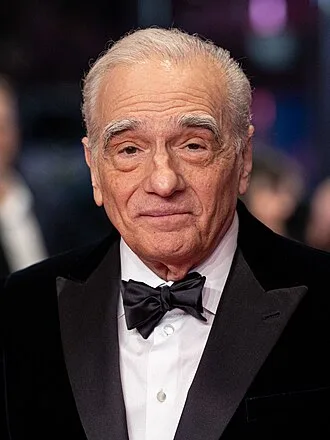
Scorsese received a Master of Arts degree from New York University in 1968. His directorial debut, Who's That Knocking at My Door (1967), was accepted into the Chicago Film Festival. In the 1970s and 1980s, Scorsese's films, much influenced by his Italian-American background and upbringing in New York City, centered on macho-posturing men and explore crime, machismo, nihilism and Catholic concepts of guilt and redemption.
His trademark styles of extensive use of slow motion and freeze frames, voice-over narration, graphic depictions of extreme violence, liberal use of profanity and collaboration with Robert De Niro were first shown in Mean Streets (1973).
Scorsese continued his association with De Niro directing him in nine more films, including Taxi Driver (1976), New York, New York (1977), Raging Bull (1980), The King of Comedy (1982), Goodfellas (1990), Cape Fear (1991), Casino (1995), and The Irishman (2019). In the following decades, he also garnered box office success with a series of six collaborations with Leonardo DiCaprio, including Gangs of New York (2002), The Aviator (2004), The Departed (2006)—which won him the Academy Award for Best Director—Shutter Island (2010), and The Wolf of Wall Street (2013).
He worked with both De Niro and DiCaprio on Killers of the Flower Moon (2023). He also directed After Hours (1985), The Color of Money (1986), The Last Temptation of Christ (1988), The Age of Innocence (1993), Kundun (1997), Hugo (2011), and Silence (2016).
In television, Scorsese has directed episodes for the HBO series Boardwalk Empire (2010–2014) and Vinyl (2016), as well as the HBO documentary Public Speaking (2010) and the Netflix docu-series Pretend It's a City (2021). He has also made several documentaries focusing on rock music such as The Last Waltz (1978), No Direction Home (2005), and Shine a Light (2008) as well as film history with A Personal Journey with Martin Scorsese Through American Movies (1995) and My Voyage to Italy (1999).
An advocate for film preservation and restoration, he has founded three nonprofit organizations including The Film Foundation in 1990. His life was profiled in the Apple TV+ docuseries Mr. Scorsese (2025).
Early life and education
Martin Charles Scorsese was born in the Flushing neighborhood of New York City's Queens borough on November 17, 1942. He grew up in the Little Italy neighborhood of the city's Manhattan borough. Both of his parents, Catherine Scorsese (née Cappa) and Charles Scorsese, worked in the Garment District. Charles was a clothes presser and actor, while Catherine was a seamstress and an actress.[citation needed] All four of Scorsese's grandparents were Italian immigrants from Sicily, hailing from Polizzi Generosa on his father's side and Ciminna on his mother's side.
The original surname of the family was Scozzese, meaning "Scot" or "Scottish" in Italian, and was changed to Scorsese because of a transcription error.
Scorsese was raised in a predominantly Catholic environment. As a boy, he had asthma and could not play sports or take part in any activities with other children, so his parents and his older brother would often take him to movie theaters; it was at this stage in his life that he developed a passion for cinema. He has spoken of the influence on him of Powell and Pressburger's Black Narcissus (1947) and The Red Shoes (1948).
As a teenager living in Brooklyn, he frequently commuted to the Bronx to rent Powell and Pressburger's film, The Tales of Hoffmann (1951), from a store which had only one copy of the reel. He was one of only two people who regularly rented it; the other, George A. Romero, who then lived in that borough, also became a director.
Scorsese has named Sabu and Victor Mature as his favorite actors in his youth. He recalls his father taking him to see Jean Renoir's The River (1951) and being fascinated by its depiction of India. He became "obsessed" with Renoir's La Grande Illusion (1937) when it was rereleased. He names John Ford's The Quiet Man (1952) and The Searchers (1956) as formative influences.
In a documentary on Italian neorealism, he commented on how Roberto Rossellini's Rome, Open City (1945) and Vittorio De Sica's Bicycle Thieves (1946) inspired him and influenced his view of his Sicilian roots. In his documentary Il Mio Viaggio in Italia (My Voyage to Italy), Scorsese noted that the Sicilian episode of Rossellini's Paisà (1946), which he first saw on television with his relatives who were themselves Sicilian immigrants, had a significant impact on his life.
He remembers responding "very strongly" to Alfred Hitchcock's Vertigo (1958). He acknowledges owing a great debt to the French New Wave and has stated that "the French New Wave has influenced all filmmakers who have worked since, whether they saw the films or not." He has also cited the works of Satyajit Ray, Ingmar Bergman, Andrzej Wajda, Michelangelo Antonioni, Federico Fellini, Ishirō Honda and Eiji Tsuburaya as major influences on his career.
Although there was no habit of reading at home, towards the end of the 1950s, Scorsese began to approach literature, being marked in particular by Fyodor Dostoevsky's Notes from Underground (1864), James Joyce's A Portrait of the Artist as a Young Man (1916) and Graham Greene's The Heart of the Matter (1948).
Scorsese attended the all-boys Cardinal Hayes High School in the Bronx, graduating in 1960. He had initially desired to become a priest, attending a preparatory seminary, but failed after the first year and was unable to attend Fordham University. This gave way to cinema and consequently Scorsese enrolled in New York University's Washington Square College (now known as the College of Arts and Science), where he earned a bachelor's degree in English in 1964.
He went on to earn his Master of Arts from NYU's School of Education (now the Steinhardt School of Culture, Education, and Human Development) in 1968, a year after the school was founded.
Career
1963–1972: Short films and feature debut
While attending the Tisch School of the Arts, Scorsese made the short films What's a Nice Girl like You Doing in a Place like This? (1963) and It's Not Just You, Murray! (1964). His most famous short of the period is the darkly comic The Big Shave (1967), which features Peter Bernuth. The film is an indictment of America's involvement in Vietnam, suggested by its alternative title Viet '67.
Scorsese has mentioned on several occasions that he was greatly inspired in his early days at New York University by Armenian-American film professor Haig P. Manoogian, calling his teachings "the most precious gift I have ever received". Scorsese's first professional job was when he was at NYU; he was the assistant cameraman to cinematographer Baird Bryant on the John G.
Avildsen directed short film Smiles (1964). Scorsese stated: "It was really important because they were filming on 35mm". He stated he was terrible at the job because he could not judge the distance of the focus. He also worked as a gaffer for Albert and David Maysles and as an editor for CBS News, the latter of whom offered him a full time position, but Scorsese declined due to his pursuit in film.
In 1967, Scorsese made his first feature-length film, the black and white I Call First, later retitled Who's That Knocking at My Door, with his fellow students actor Harvey Keitel and editor Thelma Schoonmaker, both of whom were to become long-term collaborators. Roger Ebert saw the film at the 1967 Chicago International Film Festival and wrote, in Scorsese's first published review: "it brings together two opposing worlds of American cinema.
On the one hand, there have been traditional films like Marty, View from the Bridge, On the Waterfront and David and Lisa -- all sincere attempts to function at the level where real lives are led and all suffering to some degree from their makers' romantic and idealistic ideas, about such lives.
On the other hand, there have been experimental films from Jonas Mekas, Shirley Clarke and other pioneers of the New York underground. In The Connection, Shadows and Guns of the Trees, they used improvised dialog and scenes and hidden and hand-held cameras in an attempt to capture the freshness of a spontaneous experience ... I Call First brings these two kinds of films together into a work that is absolutely genuine, artistically satisfying and technically comparable to the best films being made anywhere. I have no reservations in describing it as a great moment in American movies."
Scorsese became friends with the influential "movie brats" of the 1970s: Brian De Palma, Francis Ford Coppola, George Lucas and Steven Spielberg. It was De Palma who introduced Scorsese to Robert De Niro. During this period, Scorsese worked as the assistant director and one of the editors on Michael Wadleigh's documentary Woodstock (1970) and met actor–director John Cassavetes, who became a close friend and mentor.
Scorsese met Roger Corman after coming to Hollywood to edit Medicine Ball Caravan and Corman, who had seen and liked Who's That Knocking at My Door, asked Scorsese to make a sequel to Bloody Mama (1970). This came to be Boxcar Bertha (1972). It was Corman who taught Scorsese that entertaining films could be shot with very little money or time, preparing the young director well for the challenges to come.
Following the film's release, Cassavetes encouraged Scorsese to make the films that he wanted to make, rather than someone else's projects.
1973–1989: Breakthrough and acclaim
Mean Streets was a breakthrough for Scorsese, Keitel and Robert De Niro. Pauline Kael wrote: "Martin Scorsese's Mean Streets is a true original of our time, a triumph of personal filmmaking. It has its own hallucinatory look; the characters live in the darkness of bars, with lighting and color just this shade of lurid ...
It's about American life here and now, and it doesn't look like an American movie, or feel like one. If it were subtitled, we could hail a new European or South American talent — a new Buñuel steeped in Verdi, perhaps." By now the signature Scorsese style was in place: macho posturing, bloody violence, Catholic guilt and redemption, gritty New York locale (though the majority of Mean Streets was shot in Los Angeles), rapid-fire editing, and a soundtrack with contemporary music.
Although the film was innovative, its wired atmosphere, edgy documentary style, and gritty street-level direction owed a debt to Cassavetes, Samuel Fuller and early Jean-Luc Godard. In 1974, actress Ellen Burstyn chose Scorsese to direct her in Alice Doesn't Live Here Anymore, for which she won an Academy Award for Best Actress.
Although well regarded, the film remains an anomaly in Scorsese's early career as it focuses on a central female character. Returning to Little Italy to explore his ethnic roots, Scorsese directed Italianamerican (1974), a documentary featuring his parents Charles and Catherine Scorsese.
Scorsese followed with Taxi Driver in 1976, which depicted a Vietnam veteran who takes the law into his own hands on New York's crime-ridden streets. The film established him as an accomplished filmmaker and also brought attention to cinematographer Michael Chapman, whose style tends towards high contrasts, strong colors, and complex camera movements.
The film starred De Niro as the angry and alienated Travis Bickle, and co-starred Jodie Foster in a highly controversial role as an underage prostitute, with Harvey Keitel as her pimp. Taxi Driver also marked the start of a series of collaborations between Scorsese and writer Paul Schrader, whose influences included the diary of would-be assassin Arthur Bremer, John Ford's The Searchers (1956), and Robert Bresson's Pickpocket (1959).
Already controversial upon its release, Taxi Driver hit the headlines again five years later, when John Hinckley Jr. made an assassination attempt on then-president Ronald Reagan. He subsequently blamed his act on his obsession with Jodie Foster's Taxi Driver character (in the film, De Niro's character, Travis Bickle, makes an assassination attempt on a senator).
Taxi Driver won the Palme d'Or at the 1976 Cannes Film Festival, also receiving four Oscar nominations, including Best Picture. The critical and financial success of Taxi Driver encouraged Scorsese to move ahead with his first big-budget project: the highly stylized musical New York, New York.
This tribute to Scorsese's home town and the classic Hollywood musical was a box-office failure. The film was the director's third collaboration with De Niro, co-starring with Liza Minnelli. The film is best remembered today for the title theme song, which was popularized by Frank Sinatra. Although possessing Scorsese's usual visual panache and stylistic bravura, many critics felt its enclosed studio-bound atmosphere left it leaden in comparison with his earlier work. Despite its weak reception, the film is regarded positively by some critics. Richard Brody wrote:
For Scorsese, a lifelong cinephile, the essence of New York could be found in its depiction in classic Hollywood movies. Remarkably, his backward-looking tribute to the golden age of musicals and noirish romantic melodramas turned out to be one of his most freewheeling and personal films.
In 1977, he directed the Broadway musical The Act, starring Minnelli. The disappointing reception of New York, New York drove Scorsese into depression. By this stage Scorsese had developed a serious cocaine addiction. However, he did find the creative drive to make the highly regarded The Last Waltz, documenting the final concert by The Band.
It was held at the Winterland Ballroom in San Francisco on Thanksgiving Day, 1976, and featured one of the most extensive lineups of prominent guest performers at a single concert, including Bob Dylan, Neil Young, Ringo Starr, Muddy Waters, Joni Mitchell, Van Morrison, Paul Butterfield, Neil Diamond, Ronnie Wood and Eric Clapton.
However, Scorsese's commitments to other projects delayed the release of the film until 1978. Another Scorsese-directed documentary, titled American Boy, also appeared in 1978, focusing on Steven Prince, Scorcese's personal assistant who had a small cameo as a cocky gun salesman in Taxi Driver. A period of wild partying followed, damaging Scorsese's already fragile health. Scorsese helped provide footage for the documentary Elvis on Tour.
By several accounts (Scorsese's included), De Niro saved Scorsese's life when he persuaded him to kick his cocaine addiction to make his highly regarded film Raging Bull. Mark Singer summarized Scorsese's condition:
He (Scorsese) was more than mildly depressed. Drug abuse, and abuse of his body in general, culminated in a terrifying episode of internal bleeding. Robert De Niro came to see him in the hospital and asked, in so many words, whether he wanted to live or die. If you want to live, De Niro proposed, let's make this picture—referring to Raging Bull, an as-told-to book by Jake LaMotta, the former world middleweight boxing champion, that De Niro had given him to read years earlier.
📚 Source: Wikipedia