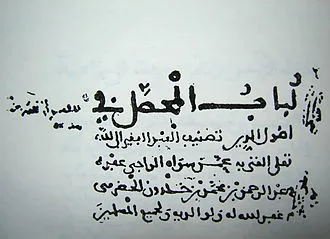
Ibn Khaldun wrote the work in 1377 as the introduction and the first book of his planned work of world history, the Kitab al-ʿIbar ("Book of Lessons"; full title: Kitābu l-ʻibari wa Dīwāni l-Mubtada' wal-Ḥabar fī ayāmi l-ʻarab wal-ʿajam wal-barbar, waman ʻĀsarahum min Dhawī sh-Shalṭāni l-Akbār, i.e.: "Book of Lessons, Record of Beginnings and Events in the history of the Arabs and Foreigners and Berbers and their Powerful Contemporaries"), but already in his lifetime it became regarded as an independent work on its own.
Etymology
Muqaddimah (مُقَدِّمَة) is an Arabic word used to mean "prologue" or "introduction", to introduce a larger work.
Content
Ibn Khaldun starts the Muqaddimah with a thorough criticism of the mistakes regularly committed by his fellow historians and the difficulties which await the historian in his work. He notes seven critical issues:
All records, by their very nature, are liable to error...
- ...Partisanship towards a creed or opinion...
- ...Over-confidence in one's sources...
- ...The failure to understand what is intended...
- ...A mistaken belief in the truth...
- ...The inability to place an event in its real context...
- ...The common desire to gain favor of those of high ranks, by praising them, by spreading their fame...
- ...The most important is the ignorance of the laws governing the transformation of human society.
Against the seventh point (the ignorance of social laws) Ibn Khaldun lays out his theory of human society in the Muqaddimah.
Sati' al-Husri suggested that Ibn Khaldun's Muqaddimah is essentially a sociological work, sketching over its six books a general sociology; a sociology of politics; a sociology of urban life; a sociology of economics; and a sociology of knowledge.
Scientific method
Ibn Khaldun often criticized "idle superstition and uncritical acceptance of historical data". As a result, he introduced the scientific method to the social sciences, which was considered something "new to his age", and he often referred to it as his "new science" and developed his own new terminology for it.
History of the Muqaddimah
Ibn Khaldun wrote the first version of the Muqaddimah in Qalʿat ibn Salama, where he secluded himself for almost four years after withdrawing from political life. It is the first of three parts of a project he worked on for almost thirty years: his Kitab al-ʿIbar, a massive work of universal history filling seventeen volumes of 500 pages each in its modern edition.
A draft of the Muqaddimah was completed in 1377. Manuscripts of the Muqaddimah copied in the lifetime of Ibn Khaldun are extant, and a number of them have autographed marginal notes or additions.
In the Muqaddimah, Ibn Khaldun expounds on a "new science" around which he had maintained secrecy up until his retirement to Qalʿat ibn Salama, a new science for the study of what he calls "ʿumrān" (عُمران). This new science, ʿilm al-ʿumrān (عِلم العُمران), was based on Greco-Arab philosophy and sought to study the evolution of humankind and society throughout history using a method that was essentially historical, empirical, rational, and demonstrative.
The Muqaddimah—shaped by Ibn Khaldun's characteristic moderation with regard to politics and religion—was met without much enthusiasm or clear hostility in the first few centuries after it was written. It was alluded to in the works of two Moroccan writers, Muḥammad Ibn al-Sakkāk (d. 1413) and Yaʿqūb b.
Mūsā al-Saytānī, but Muḥammad b. ʿAlī Ibn al-Azraq (d. 1496) is apparently the only contemporary writer of the Maghreb who clearly approved of his work, quoting from it abundantly in his Badāʾiʿ al-silk fī ṭabāʾiʿ al-mulk (كتاب بدائع السلك في طبائع الملك).
It was cited more often in works from Egypt, celebrated by disciples including Al-Maqrizi (1364–1442) and Ibn ʿAmmār, and met with hostility by others such as Ibn Hajar al-Asqalani and his master Nur al-Din al-Haythami.
In the following centuries, Khaldun appeared prominently, described as an authority on political history, in numerous biographical dictionaries—especially in Ahmed Muhammad al-Maqqari's Nafḥ al-ṭīb min ghuṣn al-Andalus al-raṭīb —but the Muqaddimah remained largely absent.
Ottoman historians including Kâtip Çelebi (d. 1657) and Mustafa Naima (d. 1716) valued the social and political theories in the Muqaddimah, but did not apply them in the analysis of their own society. The first five out of six chapters were translated into Ottoman Turkish by Mehmed Pirizade (d. 1749), and the sixth chapter was translated by Ahmed Cevdet (d. 1895); the complete translation was published 1860/61.
The Muqaddimah was first printed in 1857 at the Bulaq Press in Cairo in a standalone volume made by Naṣr al-Hūrīnī, with crucial support from Rifa'a at-Tahtawi, and as the first volume in a seven-volume set of Kitab al-ʿIbar a decade later.
Abdesselam Cheddadi concludes that "the strictly scientific contribution of Ibn Khaldūn to the field of history and the social sciences was not fully recognised in the Muslim world until the late nineteenth century."
The Muqaddimah was first discovered in France through the partial Turkish translation of Mehmed Pirizade (d. 1749). In 1858, the year following the first publication in Cairo, Étienne-Marc Quatremère printed an edition of the Arabic text of the Muqaddimah in three volumes in Paris under the title Les Prolégomènes d’Ebn Khaldoun. William McGuckin de Slane published a French translation in three volumes in 1863 that Aziz al-Azmeh regards as the best translation of Ibn Khaldun's text.
An English translation was published by Franz Rosenthal in 1958.
Sociology
ʿAsabiyyah
The concept of "ʿasabiyyah" (Arabic: "tribalism, clanism, communitarism", or in a modern context, "group feeling", "social cohesion", "solidarity" or even "nationalism") is one of the best known aspects of the Muqaddimah. As this ʿasabiyyah declines, another more compelling ʿasabiyyah may take its place; thus, civilizations rise and fall, and history describes these cycles of ʿasabiyyah as they play out.
Ibn Khaldun argues that each dynasty has within itself the seeds of its own downfall. He explains that ruling houses tend to emerge on the peripheries of great empires and use the unity presented by those areas to their advantage in order to bring about a change in leadership. As the new rulers establish themselves at the center of their empire, they become increasingly lax and more concerned with maintaining their lifestyles.
Thus, a new dynasty can emerge at the periphery of their control and effect a change in leadership, beginning the cycle anew.
Economics
Ibn Khaldun wrote on economic and political theory in the Muqaddimah, relating his thoughts on ʿasabiyyah to the division of labor: the greater the social cohesion, the more complex the division may be, the greater the economic growth:
When civilization [population] increases, the available labor again increases. In turn, luxury again increases in correspondence with the increasing profit, and the customs and needs of luxury increase. Crafts are created to obtain luxury products. The value realized from them increases, and, as a result, profits are again multiplied in the town.
Production there is thriving even more than before. And so it goes with the second and third increase. All the additional labor serves luxury and wealth, in contrast to the original labor that served the necessity of life.
Ibn Khaldun noted that growth and development positively stimulate both supply and demand, and that the forces of supply and demand are what determine the prices of goods. He also noted macroeconomic forces of population growth, human capital development, and technological developments effects on development. Ibn Khaldun held that population growth was a function of wealth.
He understood that money served as a standard of value, a medium of exchange, and a preserver of value, though he did not realize that the value of gold and silver changed based on the forces of supply and demand. Ibn Khaldun also introduced the labor theory of value. He described labor as the source of value, necessary for all earnings and capital accumulation, obvious in the case of craft.
He argued that even if earning "results from something other than a craft, the value of the resulting profit and acquired (capital) must (also) include the value of the labor by which it was obtained. Without labor, it would not have been acquired."
Ibn Khaldun describes a theory of prices through his understanding that prices result from the law of supply and demand. He understood that when a good is scarce and in demand, its price is high and when the good is abundant, its price is low.
The inhabitants of a city have more food than they need. Consequently, the price of food is low, as a rule, except when misfortunes occur due to celestial conditions that may affect [the supply of] food.
His theory of ʿasabiyyah has often been compared to modern Keynesian economics, with Ibn Khaldun's theory clearly containing the concept of the multiplier. A crucial difference, however, is that whereas for John Maynard Keynes it is the middle class's greater propensity to save that is to blame for economic depression, for Ibn Khaldun it is the governmental propensity to save at times when investment opportunities do not take up the slack which leads to aggregate demand.
Another modern economic theory anticipated by Ibn Khaldun is supply-side economics. He "argued that high taxes were often a factor in causing empires to collapse, with the result that lower revenue was collected from high rates." He wrote:
It should be known that at the beginning of the dynasty, taxation yields a large revenue from small assessments. At the end of the dynasty, taxation yields a small revenue from large assessments.
Laffer curve
Ibn Khaldun introduced the concept now popularly known as the Laffer curve, that increases in tax rates initially increase tax revenues, but eventually the increases in tax rates cause a decrease in tax revenues. This occurs as too high a tax rate discourages producers in the economy.
Ibn Khaldun used a dialectic approach to describe the sociological implications of tax choice (which now forms a part of economics theory):
In the early stages of the state, taxes are light in their incidence, but fetch in a large revenue ... As time passes and kings succeed each other, they lose their tribal habits in favor of more civilized ones. Their needs and exigencies grow ... owing to the luxury in which they have been brought up. Hence they impose fresh taxes on their subjects ...and sharply raise the rate of old taxes to increase their yield ...
But the effects on business of this rise in taxation make themselves felt. For business men are soon discouraged by the comparison of their profits with the burden of their taxes ... Consequently production falls off, and with it the yield of taxation.[citation needed]
This analysis is very similar to the modern economic concept known as the Laffer curve. Laffer does not claim to have invented the concept himself, noting that the idea was present in the work of Ibn Khaldun and, more recently, John Maynard Keynes.
Historiography
The Muqaddimah is also held to be a foundational work for the schools of historiography, cultural history, and the philosophy of history. The Muqaddimah also laid the groundwork for the observation of the role of state, communication, propaganda and systemic bias in history.[citation needed]
Franz Rosenthal wrote in the History of Muslim Historiography:
Muslim historiography has at all times been united by the closest ties with the general development of scholarship in Islam, and the position of historical knowledge in MusIim education has exercised a decisive influence upon the intellectual level of historical writing....The Muslims achieved a definite advance beyond previous historical writing in the sociological understanding of history and the systematisation of historiography.
The development of modern historical writing seems to have gained considerably in speed and substance through the utilization of a Muslim Literature which enabled western historians, from the seventeenth century on, to see a large section of the world through foreign eyes. The Muslim historiography helped indirectly and modestly to shape present day historical thinking.
Historical method
The Muqaddimah states that history is a philosophical science, and historians should attempt to refute myths. Ibn Khaldun approached the past as strange and in need of interpretation. The originality of Ibn Khaldun was to claim that the cultural difference of another age must govern the evaluation of relevant historical material, to distinguish the principles according to which it might be possible to attempt the evaluation, and lastly, to feel the need for experience, in addition to rational principles, in order to assess a culture of the past.
Ibn Khaldun often criticized "idle superstition and uncritical acceptance of historical data". As a result, he introduced a scientific method to the study of history, which was considered something "new to his age", and he often referred to it as his "new science", now associated with historiography.
Philosophy of history
Ibn Khaldun is considered a pioneer of the philosophy of history. Dawood writes on the Muqaddimah:
It can be regarded as the earliest attempt made by any historian to discover a pattern in the changes that occur in man's political and social organization. Rational in its approach, analytical in its method, encyclopaedic in detail, it represents an almost complete departure from traditional historiography, discarding conventional concepts and cliches and seeking, beyond the mere chronicle of events, an explanation—and hence a philosophy of history.
Systemic bias
The Muqaddimah emphasized the role of systemic bias in affecting the standard of evidence. Khaldun was quite concerned with the effect of raising the standard of evidence when confronted with uncomfortable claims, and relaxing it when given claims that seemed reasonable or comfortable. He was a jurist, and sometimes participated reluctantly in rulings that he felt were coerced, based on arguments he did not respect.
Besides al-Maqrizi (1364–1442), Ibn Khaldun's focused attempt systematically to study and account for biases in the creation of history wouldn't be seen again until Georg Hegel, Karl Marx, and Friedrich Nietzsche[citation needed] in 19th-century Germany, and Arnold J. Toynbee, a 20th-century British historian.[citation needed]
Ibn Khaldun also examines why, throughout history, it has been common for historians to sensationalize historical events and, in particular, exaggerate numerical figures:
Whenever contemporaries speak about the dynastic armies of their own or recent times, and whenever they engage in discussions about Muslim or Christian soldiers, or when they get to figuring the tax revenues and the money spent by the government, the outlays of extravagant spenders, and the goods that rich and prosperous men have in stock, they are quite generally found to exaggerate, to go beyond the bounds of the ordinary, and to succumb to the temptation of sensationalism.
When the officials in charge are questioned about their armies, when the goods and assets of wealthy people are assessed, and when the outlays of extravagant spenders are looked at in ordinary light, the figures will be found to amount to a tenth of what those people have said. The reason is simple. It is the common desire for sensationalism, the ease with which one may just mention a higher figure, and the disregard of reviewers and critics.
Military history
The Muqaddimah criticizes certain accounts of historical battles that appear to be exaggerated, and takes military logistics into account when questioning the sizes of historical armies reported in earlier sources. In the Introduction to the Muqaddimah, Ibn Khaldun directs this criticism towards to famous historians such as Al-Masudi, who is today regarded as the "Herodotus of the Arabs" and whom Ibn Khaldun himself regarded as one of the most famous historians up until his time.
As an example, Ibn Khaldun notes that Al-Masudi and other historians reported that Moses counted the Israelite army as 600,000 or more soldiers. Ibn Khaldun criticizes Al-Masudi for failing to take into account certain logistics, questioning whether Egypt and Syria could have possibly held such a large number of soldiers, or whether an army of that size would be able to march or fight as a unit.
He notes that the whole available territory would have been too small for such a large army, and argues that if "it were in battle formation, it would extend" several times "beyond the field of vision." He questions how two such parties could "fight with each other, or one battle formation gain the upper hand when one flank does not know what the other flank is doing", and that a coordinated battle movement in such a large group "would hardly be possible".
He argues that the "situation in the present day testifies to the correctness of this statement" since the "past resembles the future more than one drop of water another". He then compares it to the Persian Sasanian Empire, noting that it was far more vast than the Israelite Kingdom and yet the size of the military of the Sasanian Empire at the Battle of al-Qādisiyyah amounted to 120,000 troops at most (citing the 8th-century historian Sayf ibn Umar).
The Muqaddimah states that if the Israelites really did have such a large army, the extent of their empire would have been far larger, as "the size of administrative units and provinces under a particular dynasty is in direct proportion to the size of its militia and the groups that support the dynasty".
The Muqaddimah further notes that Moses lived only a few generations after Jacob, the founder of the Israelite tribes, according to the Levite tribe genealogy, as described by Al-Masudi. Ibn Khaldun argues that it "is improbable that the descendants of one man could branch out into such a number within four generations".
He states that Jews have claimed the unrealistically large increase in the Israelite population within several generations was possible because it was a miracle of God, a claim that Ibn Khaldun did not dismiss completely. He considers such a miracle highly unlikely, but appears to be open to the possibility.
Islamic theology
The Muqaddimah contains discussions on Islamic theology which show that Ibn Khaldun was a follower of the orthodox Ash'ari school of Sunni Islamic thought and a supporter of al-Ghazali's religious views. He was also a critic of Neoplatonism, particularly its notion of a hierarchy of being.[citation needed]
The Muqaddimah covers the historical development of kalam and the different schools of Islamic thought, notably the Mu'tazili and Ash'ari schools. Ibn Khaldun, being a follower of the Ash'ari school, criticizes the views of the Mu'tazili school, and bases his criticisms on the views of Abu al-Hasan al-Ash'ari, whom he describes as "the mediator between different approaches in the kalam".
Ibn Khaldun also covers the historical development of Islamic logic in the context of theology, as he viewed logic as being distinct from early Islamic philosophy, and believed that philosophy should remain separate from theology. The book also contains commentaries on verses from the Qur'an.
Islamic psychology
In Islamic psychology, Ibn Khaldun wrote the following on dream interpretation:
Often, we may deduce (the existence of) that high spiritual world and the essences it contains, from visions and things we had not been aware of while awake but which we find in our sleep and which are brought to our attention in it and which, if they are true (dreams), conform with actuality. We thus know that they are true and come from the world of truth. "Confused dreams", on the other hand, are pictures of the imagination that are stored inside by perception and to which the ability to think is applied, after (man) has retired from sense perception.
Science of hadith
Ibn Khaldun discussed the science of hadith. He disagreed with the use of reason in the evaluation of a hadith, arguing that "there is no place for the intellect in them, save that the intellect may be used in connection with them to relate problems of detail with basic principles."
On the authority of the Sahih al-Bukhari, the Muqaddimah also argues that, despite the Islamic belief that the Torah was altered by the Jews, the Muslims should neither believe nor disbelieve historical claims concerning the Torah made by Jews and Christians, particularly in regards to miraculous events. He states that:
the statement concerning the alteration (of the Torah by the Jews) is unacceptable to thorough scholars and cannot be understood in its plain meaning, since custom prevents people who have a (revealed) religion from dealing with their divine scriptures in such a manner. This was mentioned by al-Bukhari in the Sahih.
Rosenthal however comments on this, saying he is unsure exactly which tradition Ibn Khaldun is referring to, noting that al-Bukhari certainly believed in the alteration of the Torah by the Jews, suggesting that Ibn Khaldun was perhaps referring to the oft-quoted tradition that Muslims should neither believe nor disbelieve such statements of the Jews and Christians.