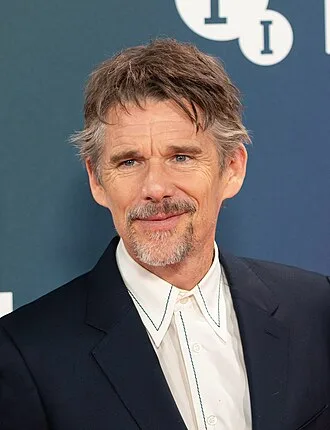
Oscar Isaac
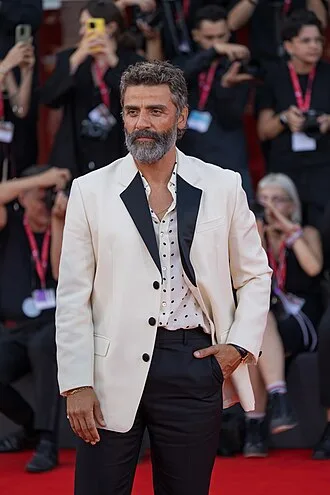
Born in Guatemala, Isaac moved with his family to the United States as an infant. As a teenager, he joined a punk band, acted in plays and made his film debut in a minor role. A graduate of the Juilliard School, Isaac was a character actor in films for much of the 2000s. His first major role was that of Joseph in the biblical drama The Nativity Story (2006), and he won an AACTA Award for Best Actor in a Supporting Role for portraying political leader José Ramos-Horta in the Australian film Balibo (2009).
After gaining recognition for playing supporting parts in Robin Hood (2010) and Drive (2011), Isaac had his breakthrough with the eponymous role of a singer in the musical drama Inside Llewyn Davis (2013), which earned him a Golden Globe nomination.
Isaac's career progressed with leading roles in the crime drama A Most Violent Year (2014), the thriller Ex Machina (2015) and the superhero film X-Men: Apocalypse (2016). He became a global star with the role of Poe Dameron in the Star Wars sequel trilogy (2015–2019). Isaac starred in the historical drama Operation Finale (2018)—which marked his first venture into production—the science fiction films Annihilation (2018), Dune (2021), and Frankenstein (2025), the crime drama The Card Counter (2021), and the animated superhero film Spider-Man: Across the Spider-Verse (2023).
On television, Isaac was the lead in three miniseries: Show Me a Hero (2015), in which his portrayal of Nick Wasicsko won him a Golden Globe Award, Scenes from a Marriage (2021), and the Marvel Cinematic Universe's Moon Knight (2022). In 2026, he also starred in the second season of the anthology series Beef. His stage work includes title roles in Romeo and Juliet (2007), Hamlet (2017) and The Sign in Sidney Brustein's Window (2023).
Early life and education
Óscar Isaac Hernández Estrada was born on March 9, 1979, in Guatemala City to a Guatemalan mother, María Eugenia Estrada Nicolle, and a Cuban father, Óscar Gonzalo Hernández-Cano, a pulmonologist. He has an older sister, climate scientist Nicole, and a younger brother, journalist Mike. Isaac's family immigrated to the US when he was five months old, and they frequently moved around the country, living in Baltimore, New Orleans and Miami, where they eventually settled.
Isaac became a United States citizen in 2006. He has French origins through his grandfather. He speaks English and Spanish.
Isaac attended the private grade school Westminster Christian School in southern Florida. Drawn to creating music and film content from a young age, he struggled growing up in Miami, which in his view was not "a flourishing place for the arts" due to its rather conservative nature. When he was four, he and his sister organized plays in their backyard.
Around age 10, Isaac made a home movie called The Avenger, in which he played dual characters; he also participated in school plays. He wrote his first play in fifth grade; it was based on the Biblical story of Noah's Ark and featured a doubtful platypus. He found great joy at performing in front of people, which provided stress relief at a time when his parents were separating and his mother became sick.
Growing up in a religious household, Isaac was a rebellious child and liked causing trouble at school. He was eventually expelled.
In 1992, Hurricane Andrew destroyed his family's home in Miami. Around this time, his parents divorced and he moved with his mother to Palm Beach, where he attended a public high school. Isaac liked his new school and formed a band with boys he met in a trailer park. He learned music, played guitar and continued to make home movies, inspired by Quentin Tarantino's work: "action [films], with lots of blood and cars".
At age 14, Isaac and his bandmates performed Nirvana's "Rape Me" at a talent show and lost. He attended Santaluces Community High School and graduated in 1998. Isaac joined a Christian ska punk band named The Blinking Underdogs, which enjoyed some success, opening for Green Day. During this time, Isaac took a two-day workshop with a casting director and won a brief part in the independent film Illtown (1998).
A chance encounter with artistic director John Rodaz at the Area Stage Company in Miami Beach resulted in several roles on stage. Isaac next secured parts in Joseph Adler's 2000 productions of This Is Our Youth and Side Man at GableStage. To avoid getting typecast as a "Latino gangster", he used Isaac as his surname at auditions." To support himself financially, he worked as an orderly at the hospital where his father worked.
Isaac considered enlisting in the Marines at one point. His father initially disapproved of this, but Isaac had recruiters convince him. Once he had taken the exam, Isaac said he wanted to do combat photography in military reserve, a job they did not offer. Instead, he studied performing arts at Miami Dade College and continued to act in plays.
During a trip to New York City to play a young Fidel Castro in an Off-Broadway production of the play When it's Cocktail Time in Cuba, he successfully auditioned to study at the Juilliard School. While a student there, he was cast in a production of Macbeth and worked on the film All About the Benjamins (2002). Isaac graduated from Juilliard with a Bachelor of Fine Arts degree in 2005.
Career
Early roles (2005–2010)
After graduating from Juilliard, Isaac continued to write music and performed in small New York clubs, and played Proteus in Two Gentlemen of Verona (2005) in The Public Theater. The following year, he portrayed Federico García Lorca in New York City Center's production of Beauty of the Father; David Rooney of Variety remarked that his "injection of wry humor provides welcome levity".
Also in 2006, he briefly appeared on the television series Law & Order: Criminal Intent, and played Joseph in the biblical epic The Nativity Story, opposite Keisha Castle-Hughes. It was the first film to hold its world premiere in the Vatican City. Having grown up in a religious family, Isaac believed it was important to portray his character "as human as possible" and approach him like any other role.
To understand Joseph's background better, he read a book titled The Life and Times of Jesus the Messiah. The film received mixed reviews and grossed $46 million against a budget of $35 million. A critic for The Abbotsford News wrote that Isaac brought the role "a freshness and vulnerability it usually" lacks.
Toddy Burton of The Austin Chronicle found Isaac "endearing", yet thought that his character's selfless personality made him seem unreal.
Isaac played Romeo alongside Lauren Ambrose in the Public Theater's Romeo and Juliet (2007). Michal Daniel of The Record believed that a "persuasively young and inexperienced" Isaac was overshadowed by Ambrose but had an enthusiastic speech and a passionate behavior. For much of the rest of the 2000s, Isaac played minor roles in films—the thriller The Life Before Her Eyes (2007), the biopic Che (2008), the spy thriller Body of Lies (2008) and the Spanish historical drama Agora (2009).
In a book published by Rutgers University Press, which analyzes the performances of rising actors in the 2010s, Rick Warner believed that Isaac "momentarily steals the scene" as a United Nations interpreter in Che. Isaac won the AACTA Award for Best Actor in a Supporting Role for his role as José Ramos-Horta in Balibo (2009).
Chris Barsanti of PopMatters opined that he played his role with "improbable charm". According to R. Kurt Osenlund of Slant Magazine, Isaac became "a bona fide scene-stealer" after Balibo.
Isaac began the 2010s with the role of the villain King John in the film Robin Hood. In preparation, he read about the character and shared ideas with director Ridley Scott on how to portray him. He liked playing a villain, as he said one does not worry about having to make them likable, enabling him to display more facets of his character.
The film had a mixed critical consensus and grossed $321 million against a budget of $200 million. For R. Kurt Osenlund, Isaac skillfully overshadowed Russell Crowe (who played Robin Hood), "bringing new, magnetic venom to the done-and-done-again role".
Rick Warner wrote, "In his early minor film roles, Isaac makes the most of the few lines he is given, supplying emotional complexity not just verbally but also through his attractive face and piercing stare."
Breakthrough (2011–2014)
In 2011, Isaac received recognition for several supporting roles. His first role that year was of an asylum orderly in Zack Snyder's Sucker Punch, for which he applied extensive makeup. Isaac credited Snyder for his openness to actors' input on set. He played a security guard in Madonna's W.E. (2011), a critical failure that British Vogue saw as his "one misjudgment", although Drew Taylor of IndieWire believed he was "one of the few worthwhile aspects" of the film.
Isaac then portrayed a musician in 10 Years, in which he performed his own song "Never Had", and an ex-convict in Nicolas Winding Refn's critically acclaimed action drama Drive (2011). Initially hesitant about Drive, he accepted the offer after working out a "more nuanced" and less stereotypical version of the character with Refn and screenwriter Hossein Amini.
Todd McCarthy of The Hollywood Reporter praised Isaac's "unanticipated intelligence and sincerity"; Madison Diazm, writing for Comic Book Resources in 2022, called the film an early testament to Isaac's ability to create tension. Drive earned $81.3 million against a production budget of $15 million.
Isaac had four film releases in 2012. His first, the Mexican epic historical drama For Greater Glory, had him play a freedom fighter, for which he was nominated for an ALMA Award for Favorite Movie Actor – Supporting Role. After playing the main character's cousin in the comedy-drama Revenge for Jolly!, Isaac appeared in the action thriller The Bourne Legacy.
Director Tony Gilroy originally considered Isaac for the lead role in the latter, but the film's production company decided against casting an unknown actor. Isaac instead won the brief part of a brainwashed assassin. The film was released to a mixed critical reception and box-office success. Lizzie Logan of Vulture opined that "Isaac took a character with very little screen time and turned him into a living, breathing, hurting person". Won't Back Down, a drama on the American educational system, was Isaac's last film in 2012. It received negative reviews and was a box-office failure.
In 2013, Isaac played the titular character of a struggling folk singer in 1961 Greenwich Village in the Coen brothers' drama Inside Llewyn Davis. Isaac accepted the project due to his high regard for the Coen brothers, who in turn were impressed with his musical talent. In preparation for the part, Isaac learned the guitar technique Travis picking and worked with musicians Erik Frandsen and T Bone Burnett.
Before production began, Isaac behaved and dressed like Davis to observe people's reaction to him. The film received acclaim, as did Isaac's performance in what proved to be his breakthrough role. Critics from The Oregonian and St. Louis Post-Dispatch added that Isaac "anchors this film with a star-making, soulful performance", and "has a gift for being appealing even when he's unpleasant".
A. O. Scott of The New York Times wrote, "Isaac, a versatile character actor here ascending to the highest levels of his craft, refuses the easy road of charm. Like his character, he trusts his own professionalism and the integrity of the material." Scott opined that the musical performances elevated the film, especially Isaac's "The Death of Queen Jane" and "The Shoals of Herring".
For the film, Isaac was nominated for the Golden Globe Award for Best Actor – Motion Picture Musical or Comedy. He next starred as Laurent LeClaire, a man who seduces his friend's wife (Elizabeth Olsen) in the erotic thriller In Secret (2013). Michael Phillips of the Chicago Tribune praised Isaac as the film's prime asset, noting that his "sly delineation of the charismatic Laurent provides the through-line".
In 2014, Isaac appeared in the thriller The Two Faces of January, starring alongside Viggo Mortensen and Kirsten Dunst. He starred with Jessica Chastain in J. C. Chandor's A Most Violent Year (2014), replacing actor Javier Bardem. Described by Isaac as "a gangster movie without the gangsters", the film follows his character Abel Morales, the ambitious owner of a heating-oil company, who is determined to protect his business in a city plagued by violent crime.
Chandor first met Isaac upon Chastain's insistence and, finding him "precise, wild and alive", cast him in the part. When Isaac noticed that Morales's background was missing in the script, Chandor allowed him to create it, for which he researched Latin Americans' history in the 1950s and 1960s. Fascinated by Morales's duality—"cold, calculating businessman" but also "highly emotional and highly passionate"—Isaac read books about sociopaths and "corporate America" to prepare for the part.
The film failed to recoup its budget but was a critical success. Ann Hornaday of The Washington Post praised Isaac for "deliver[ing] a master class in that skill from the very first moment of A Most Violent Year to the last", adding, "he's a commanding screen presence, even when he's saying nothing." Tad Friend of The New Yorker believed that Isaac's portrayal was reminiscent of the work of actors Treat Williams, Dustin Hoffman and Al Pacino. For his performance in the film, Isaac won a National Board of Review Award for Best Actor.
Mainstream success (2015–2017)
In 2015, Isaac portrayed Nathan Hamlet Bateman, the reclusive inventor of a humanoid artificial intelligence, in the science fiction film Ex Machina. He based his character's look and accent on director Stanley Kubrick and observed his speech patterns. Isaac modeled Bateman's personality on chess champion Bobby Fischer and played the game during filming to get "in that mode of constantly trying to be a few steps ahead". Ex Machina was a commercial and critical success, with praise for Isaac's performance.
Matt Zoller Seitz of RogerEbert.com commended Isaac for possessing "an electrifying star quality, cruelly sneering yet somehow delightful, insinuating and intellectually credible". Isaac followed with his first leading role on television—the 6-episode HBO miniseries Show Me a Hero, in which he played politician Nick Wasicsko.
Isaac was approached for the role shortly after he had finished filming for Star Wars: The Force Awakens. Although he found the story "fascinating", he was initially reluctant to sign on as it was "a little impenetrable" for him. He agreed after finding footage of Wasicsko interacting with the media. Because a show's length generally exceeds a film's, Isaac found filming the miniseries a little more difficult and was skeptical about its six-hour format.
Isaac's performance, which won him the Golden Globe Award for Best Actor – Miniseries or Television Film, was lauded by critics. Emily Nussbaum of The New Yorker praised it as "a star performance agile enough to elevate scenes that might veer into agitprop".
Isaac co-starred as Poe Dameron, an X-wing pilot, in the epic space opera film Star Wars: The Force Awakens (2015). Having liked Star Wars films since childhood, he initially considered himself unfit for the part, but director J. J. Abrams convinced him in a meeting. A fan of Inside Llewyn Davis, Abrams described Isaac as "a far more sophisticated actor than one might get for a role".
Isaac suggested to Abrams that his character be from the moon Yavin 4, which first appeared in Star Wars (1977) in scenes filmed in his country Guatemala; this idea was incorporated. While filming The Force Awakens, Isaac initially felt insecure, but soon found a sense of belonging with co-stars Daisy Ridley and John Boyega, who were also newcomers to the film series.
In preparation for the role, Isaac read about war, including a book called What It's Like to Go to War. The Force Awakens received positive reviews and grossed $2 billion worldwide, becoming the highest-grossing film of 2015. Forbes and TheWrap critics praised the cast additions, including Isaac, as "outright terrific", and "engaging performers" who "make strong impressions very quickly, and who are charismatic enough to make us care about their characters".
Isaac agreed to play the titular villain in the film X-Men: Apocalypse (2016) because he was a fan of X-Men comic books since childhood. He underwent extensive makeup and prosthetics, and wore a 40-pound suit; the full costume was uncomfortable, which forced Isaac to go to a cooling tent between takes. Critics Angelica Jade Bastién and Glenn Kenny believed Isaac, though a "charismatic and dynamic" actor, "feel[s] so torpid here", and "fares poorly through no fault of his own".
Years after Apocalypse's underwhelming critical performance, Isaac commented that he wished the film and his character had been better handled. Also in 2016, he starred alongside Charlotte Le Bon and Christian Bale in The Promise, a historical drama about a love triangle set during the Armenian genocide.
Critics were dismissive of the film, believing that the outstanding cast and powerful real-life story was wasted on a love triangle that failed to engage. Richard Roeper of the Chicago Sun-Times wrote that the film was "derivative of better war romances" but was "bolstered by strong performances from Isaac and Bale, two of the best actors of their generation".
The film's producers intended to donate the profits to charity, but it accrued a $102 million loss. Outside film in 2016, Isaac narrated the Nike ad Unlimited You, and voiced a soldier trying to rejoin civilian life in the podcast series Homecoming.
📚 Source: Wikipedia