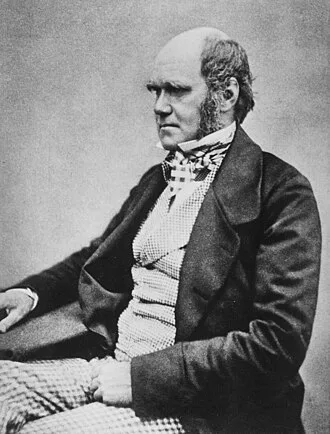
Darwin's early interest in nature led him to neglect his medical education at the University of Edinburgh; instead, he helped Robert Edmond Grant to investigate marine invertebrates. His studies at the University of Cambridge's Christ's College from 1828 to 1831 encouraged his passion for natural science. However, it was his five-year voyage on HMS Beagle from 1831 to 1836 that truly established Darwin as an eminent geologist.
The observations and theories he developed during his voyage supported Charles Lyell's concept of gradual geological change. Publication of his journal of the voyage made Darwin famous as a popular author. His first scientific work was The Structure and Distribution of Coral Reefs (1842). Along with his work on barnacles, it won him the Royal Medal in 1853.
Puzzled by the geographical distribution of wildlife and fossils he collected on the voyage, Darwin began detailed investigations and, in 1838, devised his theory of natural selection. Although he discussed his ideas with several naturalists, he needed time for extensive research, and his geological work had priority.
He was writing up his theory in 1858 when Wallace sent him an essay that described the same idea, prompting the immediate joint submission of both their theories to the Linnean Society of London. Darwin's work established evolutionary descent with modification as the dominant scientific explanation of natural diversification.
Darwin published his theory of evolution with compelling evidence in On the Origin of Species (1859). He explored coevolution in Fertilisation of Orchids (1862) and human evolution and sexual selection in The Descent of Man, and Selection in Relation to Sex (1871). The Expression of the Emotions in Man and Animals (1872) was an early work of psychology, and one of the first books to feature photographs. His final book was The Formation of Vegetable Mould, through the Actions of Worms (1881).
By the 1870s, the scientific community and a majority of the educated public had accepted evolution as a fact. However, many initially favoured competing explanations that gave only a minor role to natural selection. It was not until the emergence of the modern evolutionary synthesis from the 1930s to the 1950s that a broad consensus developed in which natural selection was the basic mechanism of evolution.
Darwin's discovery is the unifying theory of the life sciences, explaining the unity and diversity of life.
Biography
Early life and education
Charles Robert Darwin was born on 12 February 1809 at his family's home, The Mount, in Shrewsbury, Shropshire. He was the fifth of six children of wealthy society doctor and financier Robert Darwin and Susannah Darwin (née Wedgwood). His grandfathers Erasmus Darwin and Josiah Wedgwood were both prominent abolitionists.
Erasmus Darwin had praised general concepts of evolution and common descent in his Zoonomia (1794), a poetic fantasy of gradual creation including undeveloped ideas anticipating concepts his grandson expanded.
Both families were largely Unitarian, though the Wedgwoods were adopting Anglicanism. Robert Darwin, a freethinker, had baby Charles baptised in November 1809 in the Anglican St Chad's Church, Shrewsbury, but Charles and his siblings attended the local Unitarian Church with their mother. The eight-year-old Charles already had a taste for natural history and collecting when he joined the day school run by its preacher in 1817.
That July, his mother died. From September 1818, he joined his older brother Erasmus in attending the nearby Anglican Shrewsbury School as a boarder.
Darwin spent the summer of 1825 as an apprentice doctor, helping his father treat impoverished people in Shropshire, before going to the well-regarded University of Edinburgh Medical School with his brother Erasmus in October 1825. Darwin found lectures dull and surgery distressing, so he neglected his studies. He learned taxidermy in around 40 daily hour-long sessions from John Edmonstone, a Black Briton from Demerara in the South American rainforest, who had been taught there by Charles Waterton, and when brought to Scotland was freed from slavery.
In Darwin's second year at the university, he joined the Plinian Society, a student natural-history group featuring lively debates in which radical democratic students with materialistic views challenged orthodox religious concepts of science. He assisted Robert Edmond Grant's investigations of the anatomy and life cycle of marine invertebrates in the Firth of Forth, and on 27 March 1827 presented at the Plinian his own discovery that black spores found in oyster shells were the eggs of a skate leech.
One day, Grant praised Lamarck's evolutionary ideas. Darwin was astonished by Grant's audacity, but had recently read similar ideas in his grandfather Erasmus' journals. Darwin was rather bored by Robert Jameson's natural-history course, which covered geology – including the debate between neptunism and plutonism.
He learned the classification of plants. He assisted with work on the collections of the University Museum, one of the largest museums in Europe at the time.
Darwin's neglect of medical studies annoyed his father, who sent him to Christ's College, Cambridge in January 1828 to study for a Bachelor of Arts degree as the first step towards becoming an Anglican country parson. Darwin was unqualified for Cambridge's Tripos exams and was required instead to join the ordinary degree course.
He preferred riding and shooting to studying. At Cambridge, Darwin joined a society known as the "Glutton Club," which consumed "birds and beasts which were before unknown to human palate." Darwin would continue to eat the meat of exotic animals for the rest of his life; on the voyage of the Beagle, he ate puma, iguanas, giant tortoises, armadillos, and mistakenly ate a rhea which he intended to study.
During the first few months of Darwin's enrolment at Christ's College, his second cousin William Darwin Fox was still studying there. Fox impressed him with his butterfly collection, introducing Darwin to entomology and influencing him to pursue beetle collecting. He did this zealously and had some of his finds published in James Francis Stephens' Illustrations of British entomology (1829–1932).
Through Fox, Darwin became a close friend and follower of botany professor John Stevens Henslow. He met other leading parson-naturalists who saw scientific work as religious natural theology, becoming known to these dons as "the man who walks with Henslow". When his own exams drew near, Darwin applied himself to his studies and was delighted by the language and logic of William Paley's Evidences of Christianity (1795).
In his final examination in January 1831, Darwin did well, coming tenth out of 178 candidates for the ordinary degree.
Darwin had to stay at Cambridge until June 1831. He studied Paley's Natural Theology or Evidences of the Existence and Attributes of the Deity (first published in 1802), which made an argument for divine design in nature, explaining adaptation as God acting through laws of nature. He read John Herschel's new book, Preliminary Discourse on the Study of Natural Philosophy (1831), which described the highest aim of natural philosophy as understanding such laws through inductive reasoning based on observation, and Alexander von Humboldt's Personal Narrative of scientific travels in 1799–1804.
Inspired with "a burning zeal" to contribute, Darwin planned to visit Tenerife with some classmates after graduation to study natural history in the tropics. In preparation, he joined Adam Sedgwick's geology course, then on 4 August travelled with him to spend a fortnight mapping strata in Wales.
Survey voyage on HMS Beagle
After leaving Sedgwick in Wales, Darwin spent a few days with student friends at Barmouth. He returned home on 29 August to find a letter from Henslow proposing him as a suitable (if unfinished) naturalist for a self-funded supernumerary place on HMS Beagle with captain Robert FitzRoy, a position for a gentleman rather than "a mere collector".
The ship was to leave in four weeks on an expedition to chart the coastline of South America. Robert Darwin objected to his son's planned two-year voyage, regarding it as a waste of time, but was persuaded by his brother-in-law, Josiah Wedgwood II, to agree to (and fund) his son's participation. Darwin took care to remain in a private capacity to retain control over his collection, intending it for a major scientific institution.
After delays, the voyage began on 27 December 1831; it lasted almost five years. As FitzRoy had intended, Darwin spent most of that time on land investigating geology and making natural history collections, while HMS Beagle surveyed and charted coasts. He kept careful notes of his observations and theoretical speculations.
At intervals during the voyage, his specimens were sent to Cambridge together with letters including a copy of his journal for his family. He had some expertise in geology, beetle collecting and dissecting marine invertebrates, but in all other areas, was a novice and ably collected specimens for expert appraisal. Despite suffering badly from seasickness, Darwin wrote copious notes while on board the ship.
Most of his zoology notes are about marine invertebrates, starting with plankton collected during a calm spell.
On their first stop ashore at St Jago in Cape Verde, Darwin found that a white band high in the volcanic rock cliffs included seashells. FitzRoy had given him the first volume of Charles Lyell's Principles of Geology, which set out uniformitarian concepts of land slowly rising or falling over immense periods,[II] and Darwin saw things Lyell's way, theorising and thinking of writing a book on geology.
When they reached Brazil, Darwin was delighted by the tropical forest, but detested the sight of slavery there, and disputed this issue with FitzRoy.
The survey continued to the south in Patagonia. They stopped at Bahía Blanca, and in cliffs near Punta Alta, Darwin made a significant find of fossil bones of huge extinct mammals beside modern seashells, indicating recent extinction with no signs of change in climate or catastrophe. He found bony plates like a giant version of the armour on local armadillos.
From a jaw and tooth, he identified the gigantic Megatherium, then from Cuvier's description thought the armour was from this animal. The finds were shipped to England, and scientists found the fossils of great interest.
On rides with gauchos into the interior to explore geology and collect more fossils, Darwin gained social, political, and anthropological insights into both native and colonial people at a time of revolution, and learnt that two types of rhea had separate but overlapping territories. Further south, he saw stepped plains of shingle and seashells as raised beaches at a series of elevations.
He read Lyell's second volume and accepted its description of "centres of creation" of species, but his discoveries and theorising challenged Lyell's ideas of smooth continuity and of extinction of species. In Tierra del Fuego, Darwin formed the incorrect belief that the archipelago was devoid of reptiles.
Three Fuegians on board, who had been seized during the first Beagle voyage and then given Christian education in England, were returning with a missionary. Darwin found them friendly and civilised, yet at Tierra del Fuego he met "miserable, degraded savages", as different as wild from domesticated animals. He remained convinced that, despite this diversity, all humans were interrelated with a shared origin and potential for improvement towards civilisation.
Unlike his scientist friends, he now thought there was no unbridgeable gap between humans and animals. A year on, the mission had been abandoned. The Fuegian they had named Jemmy Button lived like the other natives, had a wife, and had no wish to return to England.
Darwin experienced an earthquake in Chile in 1835 and saw signs that the land had just been raised, including mussel beds stranded above high tide. High in the Andes, he saw seashells and several fossil trees that had grown on a sand beach. He theorised that as the land rose, oceanic islands sank, and coral reefs around them grew to form atolls.
On the geologically new Galápagos Islands, Darwin looked for evidence attaching wildlife to an older "centre of creation". He found mockingbirds allied to those in Chile but differing from island to island. He heard that slight variations in the shape of tortoise shells showed which island they came from, but failed to collect them, even after eating tortoises taken on board as food.
In Australia, the marsupial rat-kangaroo and the platypus seemed so unusual that Darwin thought it was almost as though two distinct Creators had been at work. He found the Aboriginal Australians "good-humoured & pleasant", their numbers depleted by European settlement.
FitzRoy investigated how the atolls of the Cocos (Keeling) Islands had formed. The survey supported Darwin's theorising. FitzRoy began writing the official Narrative of the Beagle voyages, and after reading Darwin's diary, he proposed incorporating it into the account. Darwin's Journal was eventually rewritten as a separate third volume, on geology and natural history.
In Cape Town, South Africa, Darwin and FitzRoy met John Herschel, who had recently written to Lyell praising his uniformitarianism as opening bold speculation on "that mystery of mysteries, the replacement of extinct species by others" as "a natural in contradistinction to a miraculous process". When organising his notes as the ship sailed home, Darwin wrote that, if his growing suspicions about the mockingbirds, the tortoises and the Falkland Islands fox were correct, "such facts undermine the stability of Species", then cautiously added "would" before "undermine". He later wrote that such facts "seemed to me to throw some light on the origin of species".
Without Darwin's knowledge, extracts from his letters to Henslow had been read to scientific societies, printed as a pamphlet for private distribution among members of the Cambridge Philosophical Society, and reported in magazines, including The Athenaeum. Darwin first heard of this at Cape Town, and at Ascension Island read of Sedgwick's prediction that Darwin "will have a great name among the Naturalists of Europe".
Inception of Darwin's evolutionary theory
On 2 October 1836, Beagle anchored at Falmouth, Cornwall. Darwin promptly made the long coach journey to Shrewsbury to visit his home and see relatives. He then hurried to Cambridge to see Henslow, who advised him on finding available naturalists to catalogue Darwin's animal collections and to take on the botanical specimens.
Darwin's father organised investments, enabling his son to be a self-funded gentleman scientist, and an excited Darwin went around the London institutions being fêted and seeking experts to describe the collections. British zoologists at the time had a huge backlog of work, due to the encouragement of natural history collecting throughout the British Empire, and there was a danger of specimens being left in storage.
Charles Lyell eagerly met Darwin for the first time on 29 October and soon introduced him to the up-and-coming anatomist Richard Owen, who had the facilities of the Royal College of Surgeons to work on the fossil bones collected by Darwin. Owen's surprising results included other gigantic extinct ground sloths as well as the Megatherium Darwin had identified, a near complete skeleton of the unknown Scelidotherium and a hippopotamus-sized rodent-like skull named Toxodon resembling a giant capybara.
The armour fragments were actually from Glyptodon, a huge armadillo-like creature, as Darwin had initially thought. These extinct creatures were related to living species in South America.
In mid-December, Darwin took lodgings in Cambridge to arrange expert classification of his collections and prepare his own research for publication. Questions of how to combine his diary into the Narrative were resolved at the end of the month when FitzRoy accepted Broderip's advice to make it a separate volume, and Darwin began work on his Journal and Remarks.
Darwin's first paper showed that the South American landmass was slowly rising. With Lyell's enthusiastic backing, he read it to the Geological Society of London on 4 January 1837. On the same day, he presented his mammal and bird specimens to the Zoological Society. The ornithologist John Gould soon announced that the Galápagos birds that Darwin had thought a mixture of blackbirds, "gros-beaks" and finches, were, in fact, twelve separate species of finches.
On 17 February, Darwin was elected to the Council of the Geological Society, and Lyell's presidential address presented Owen's findings on Darwin's fossils, stressing the geographical continuity of species as supporting his uniformitarian ideas.
Early in March, Darwin moved to London to be near this work, joining Lyell's social circle of scientists and experts such as Charles Babbage, who described God as a programmer of laws. Darwin stayed with his freethinking brother Erasmus, part of this Whig circle and a close friend of the writer Harriet Martineau, who promoted the Malthusianism that underpinned the controversial Whig Poor Law reforms to stop welfare from causing overpopulation and more poverty.
As a Unitarian, she welcomed the radical implications of transmutation of species, promoted by Grant and younger surgeons influenced by Geoffroy. Transmutation was anathema to Anglicans defending social order, but reputable scientists openly discussed the subject. There was broad interest in John Herschel's letter praising Lyell's approach as a way to find a natural cause of the origin of new species.
Gould met Darwin and told him that the Galápagos mockingbirds from different islands were separate species, not just varieties, and what Darwin had thought was a "wren" was in the finch group. Darwin had not labelled the finches by island, but from the notes of others on the ship, including FitzRoy, he allocated species to islands.
The two rheas were distinct species, and on 14 March Darwin announced how their distribution changed going southwards.